USAID DEC
Success Story: For Effective Municipalities, Active Communities, Safer Citizens
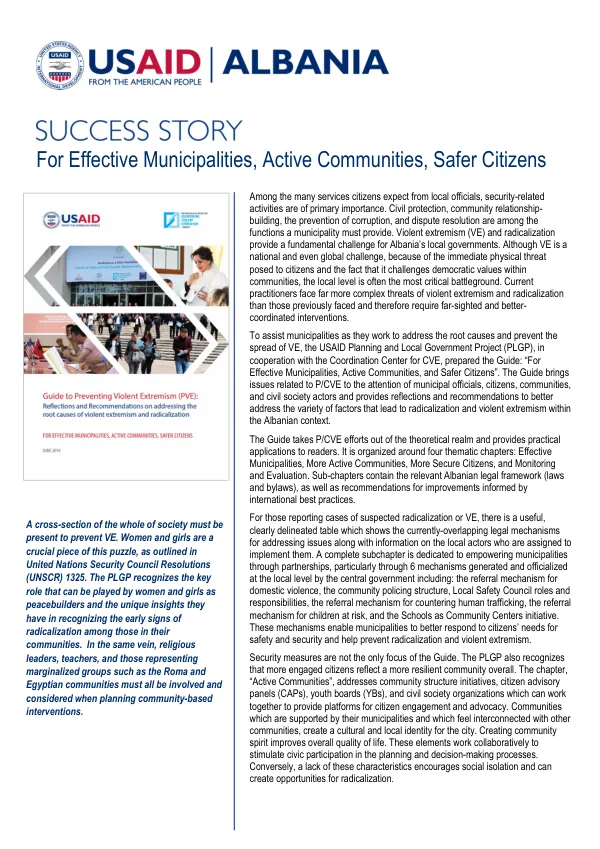
The USAID Planning and Local Government Project (PLGP) in cooperation with the Coordination Center for CVE prepared the Guide "For Effective Municipalities, Active Communities, and Safer Citizens" to assist municipalities in addressing the root causes and preventing the spread of violent extremism (VE) in Albania.
2020 · 1 pages
Sign in to readA free account is required to download.
Abstract
The Guide brings issues related to prevention and countering violent extremism (P/CVE) to the attention of municipal officials, citizens, communities, and civil society actors, providing reflections and recommendations to better address the factors that lead to radicalization and VE within the Albanian context. The Guide is organized around four thematic chapters: Effective Municipalities, More Active Communities, More Secure Citizens, and Monitoring and Evaluation. Sub-chapters contain the relevant Albanian legal framework, as well as recommendations for improvements informed by international best practices. The Guide takes P/CVE efforts out of the theoretical realm and provides practical applications to readers. For those reporting cases of suspected radicalization or VE, a clearly delineated table shows the currently-overlapping legal mechanisms for addressing issues along with information on the local actors who are assigned to implement them. Municipalities play a crucial role in preventing VE, and the Guide recognizes the key role that women and girls can play as peacebuilders and in recognizing the early signs of radicalization among those in their communities. Religious leaders, teachers, and those representing marginalized groups must also be involved and considered when planning community-based interventions. The Guide emphasizes the importance of community structure initiatives, citizen advisory panels, youth boards, and civil society organizations working together to provide platforms for citizen engagement and advocacy. The chapter "Active Communities" addresses community structure initiatives, citizen advisory panels, youth boards, and civil society organizations, which can work together to provide platforms for citizen engagement and advocacy. Communities supported by their municipalities and feeling interconnected with other communities create a cultural and local identity for the city, improving overall quality of life. Conversely, a lack of these characteristics encourages social isolation and can create opportunities for radicalization. The Guide also recognizes that more engaged citizens reflect a more resilient community overall. It provides recommendations for empowering municipalities through partnerships, particularly through six mechanisms generated and officialized at the local level by the central government. These mechanisms enable municipalities to better respond to citizens' needs for safety and security and help prevent radicalization and violent extremism. Security measures are not the only focus of the Guide, as it also emphasizes the importance of community engagement and advocacy in preventing VE.