USAID DEC
Success Story: USAID/OFDA supports multiplier training through partnerships with Mexico City’s key stakeholders
Sign inMIYAMOTO INTERNATIONAL, INC.
Success Story: USAID/OFDA supports multiplier training through partnerships with Mexico City’s key stakeholders
The USAID/OFDA Mexico City Earthquake Response Program implemented in 2017 aimed to enhance disaster preparedness and response capabilities in Mexico City.
2019 · 2 pages
Sign in to readA free account is required to download.
Abstract
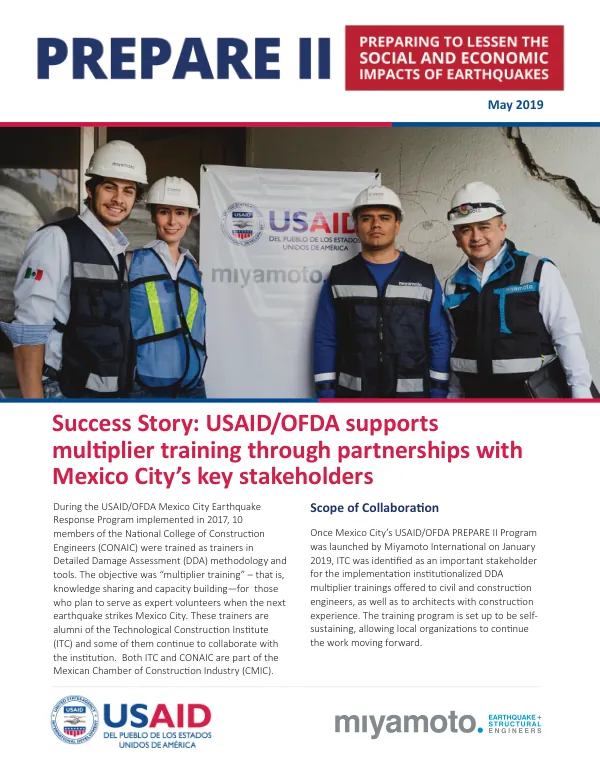
A key component of this program was the training of 10 members of the National College of Construction Engineers (CONAIC) as trainers in Detailed Damage Assessment (DDA) methodology and tools. These trainers were alumni of the Technological Construction Institute (ITC) and some continued to collaborate with the institution. The objective of the multiplier training was to equip these trainers with the knowledge and skills to serve as expert volunteers in the event of a future earthquake in Mexico City. The training program was designed to be self-sustaining, allowing local organizations to continue the work moving forward. In May 2019, USAID/OFDA supported a DDA multiplier training through partnerships with Mexico City's key stakeholders, including ITC. The training took place on May 8 and 9 at ITC and was attended by 38 participants, including 26 engineers and 12 architects. Thirteen of the participants were women. The training covered six topics, including a Q&A session, and an on-site practice session in an earthquake-damaged building. The training was a success, with the Mexican Social Security Institute requesting that ITC schedule a DDA Training for its organization immediately after the conclusion of the initial kick-off training. The training program was designed to enhance the disaster preparedness and response capabilities of Mexico City's stakeholders. The use of DDA methodology and tools was critical to evaluating earthquake-damaged buildings in detail, classifying the damages, and contributing to the city's earthquake response plans and resilience. The training program was a collaborative effort between USAID/OFDA, Miyamoto International, and local stakeholders, including ITC and CONAIC. The success of the training program was evident in the high level of participation and engagement from the stakeholders. The training program was also successful in achieving its objective of equipping the trainers with the knowledge and skills to serve as expert volunteers in the event of a future earthquake in Mexico City. The program's self-sustaining design ensured that local organizations could continue the work moving forward, enhancing the disaster preparedness and response capabilities of Mexico City's stakeholders.