USAID DEC
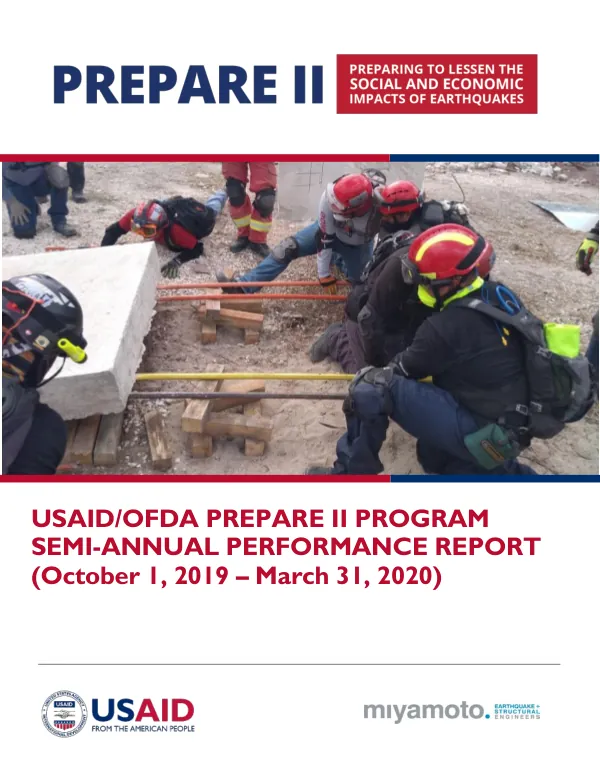
USAID/OFDA PREPARE II Program Semi-Annual Performance Report (October 1, 2019 – March 31, 2020)
Sign inMIYAMOTO INTERNATIONAL, INC.
USAID/OFDA PREPARE II Program Semi-Annual Performance Report (October 1, 2019 – March 31, 2020)
The USAID/OFDA PREPARE II Program is a 27-month initiative aimed at strengthening emergency response capacity and reducing risks from seismic and other natural hazards in five countries: Costa Rica, Colombia, Mexico, Mexico City, and El Salvador.
2020 · 13 pages
Sign in to readA free account is required to download.
Abstract
The program officially launched on September 25, 2018, and is implemented by Miyamoto International. The PREPARE II strategy emphasizes multi-stakeholder engagement to facilitate cooperation between international and national-level experts in emergency response and disaster risk reduction. The program supports a range of public sector institutions, including ministries, civil protection units, and emergency response commissions, as well as private sector partners from academia, engineering, and architecture associations, NGOs, and the business community. The program's integrated approach involves four distinct components: seismic risk assessment, rapid damage assessments, advanced draft debris management strategy, and urban search and rescue capacity strengthening. Data and findings from the seismic risk assessment inform policy and planning priorities for emergency response and disaster risk reduction, which in turn inform a strategy for technical and capacity building assistance to strengthen planning and delivery of rapid damage assessments, debris management, and urban search and rescue support activities. During the reporting period from October 1, 2019, to March 31, 2020, the program achieved significant results in capacity building and training. In Costa Rica, 53 people were trained in disaster preparedness, mitigation, and management, representing a 176% increase over the target. In Colombia, 81 people were trained, representing a 270% increase over the target. In Mexico City, 195 people were trained, representing a 975% increase over the target. In Mexico's Zapopan region, 298 people were trained, representing a 993% increase over the target. The program also made progress in policy planning, with 628 people participating in discussions regarding national risk reduction strategies. In Costa Rica, 50 people participated, representing a 167% increase over the target. In Colombia, 146 people participated, representing a 486% increase over the target. In Mexico City, 132 people participated, representing a 528% increase over the target. In terms of community and stakeholder engagement, the program involved 60 communities and stakeholders in the development of plans, policies, and strategies. In Costa Rica, 19 communities and stakeholders were involved, representing a 380% increase over the target. In Mexico's Zapopan region, 32 communities and stakeholders were involved, representing a 640% increase over the target. The program also made progress in making national and local risk assessment, hazards data, and vulnerability information available within target areas. In all five countries, the program achieved 100% of the target in making this information available. Overall, the PREPARE II Program has made significant progress in strengthening emergency response capacity and reducing risks from seismic and other natural hazards in the five countries where it operates.