USAID DEC
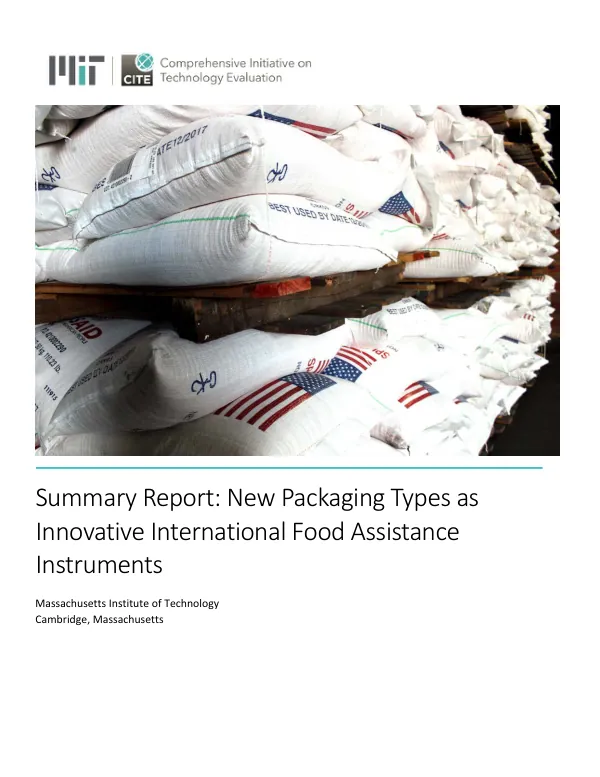
Summary Report: New Packaging Types as Innovative International Food Assistance Instruments
Sign inMASSACHUSETTS INSTITUTE OF TECHNOLOGY D-LAB
Summary Report: New Packaging Types as Innovative International Food Assistance Instruments
The Comprehensive Initiative on Technology Evaluation (CITE) at the Massachusetts Institute of Technology (MIT) conducted a study to evaluate the cost, quality, and timeliness outcomes of new packaging types for international food assistance.
2017 · 37 pages
Sign in to readA free account is required to download.
Abstract
The study was made possible through support from the United States Agency for International Development (USAID) and the U.S. Department of Agriculture (USDA). The study aimed to answer the question of whether new packaging types affect the cost and quality of food assistance procured in the United States and shipped abroad. To achieve this, a pilot procurement valued at approximately $600,000 USD was conducted, testing eight packaging types with three representative commodities shipped to two foreign ports and stored in two of USAID's prepositioning warehouses for at least three months. The study found that 25 or 50 kilogram bio-pesticide treated bags have the potential to decrease the cost relative to standard packaging types, while maintaining the quality about as well as the standard packaging type. This packaging does not require fumigation, which may improve the timeliness of USAID's food assistance efforts. The study recommends using a bio-pesticide on packaging program-wide. Additionally, the study found that 1000 kilogram bags over the long-term may bring cost benefits, conditional on some machinery and capital investments along the food assistance supply chain. In practice, it may be cost-effective to build capacity in USAID prepositioning warehouses to handle these shipping-sized bags. The study recommends using 1000 kilogram bags in the prepositioning supply chain and for some countries that regularly receive food assistance. The study also found that the commodity supplier appears to affect the quality outcomes of food assistance, perhaps more than most bag treatments or fumigation practices. Consistently observed infestation in one supplier's commodities suggests that using existing capacities in the USAID-USDA supply chain management software to better track quality is recommended. The study relied on experimental principles to design and operationalize a relatively small, non-randomized procurement, whose design and data allowed for generalizable conclusions. Partnerships between the government and universities facilitated close collaboration and an extra-mural perspective, which is recommended for future public procurement efforts. USAID's Office of Food for Peace has fed over three billion people since its inception in 1954, delivering over 1.7 million metric tons of food assistance valued at nearly $2 billion USD to over 30 million beneficiaries in 50 countries in Fiscal Year (FY) 2016. Commodity losses impact when and what type of food assistance is shipped, affecting USAID's ability to provide life-saving food assistance to vulnerable populations and reduce hunger and malnutrition. USAID estimates that about 1 percent of its food assistance that is shipped is lost, and the United Nations World Food Program (WFP) estimates that about half of its losses by value are due to quality challenges, such as poor warehousing conditions, broken bags, insect infestations, and contaminated commodities. These losses are unsurprising, considering the size and mandate of the program, as well as the long distances and varying climates across which these commodities travel. The study highlights the need to avoid or reduce the need for fumigation in food assistance supply chains to improve cost, quality, and timeliness outcomes. The findings and recommendations of the study aim to inform USAID's efforts to improve the effectiveness and efficiency of its food assistance programs.
Related documents