UNICEF
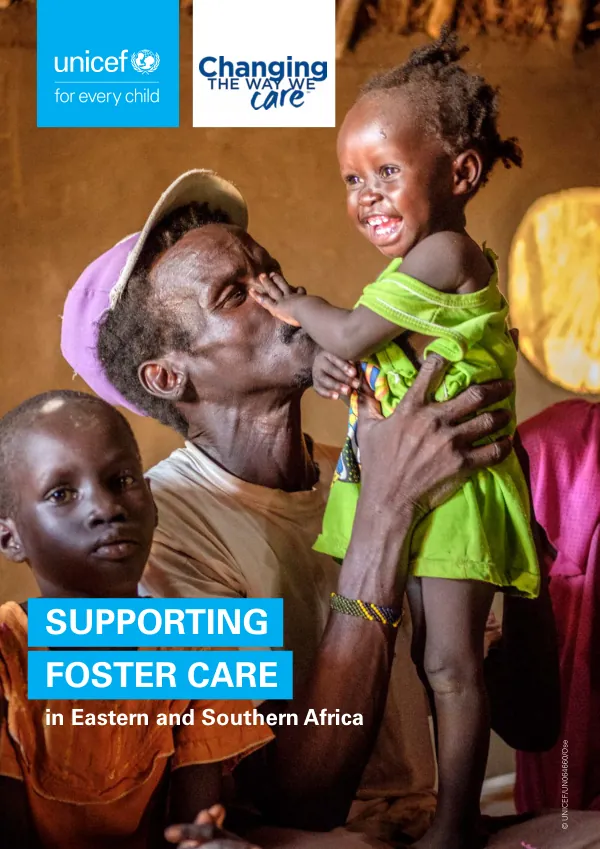
Supporting Foster Care in Eastern and Southern Africa
Foster care is a formal arrangement whereby a competent authority places children in the domestic environment of a family other than the child's own that has been selected, qualified, and approved for providing such care.
2021 · 30 pages
Sign in to readA free account is required to download.
Abstract
This form of alternative care is often seen as better than residential care as it allows children to live in a family and form strong relationships with carers. Across Eastern and Southern African governments are working to end the use of institutional care and ensure that children can grow up in safe and caring families. Foster care is increasingly used for children who cannot be looked after by their own families. There are many examples of successful foster care programmes in the region, including with disadvantaged groups such as those with disabilities. However, these initiatives are often run by non-governmental organisations (NGOs), reach only a small number of children, and are not fully integrated into national care and protection systems. Many countries struggle to establish government-run or regulated foster care at scale. This paper examines the nature and benefits of foster care and identifies some of the key challenges associated with this form of care in Eastern and Southern Africa. The paper outlines the elements of an enabling environment needed for successful large-scale foster care programmes, including legislation, guidance, changes to social norms, coordination mechanisms, and a strong social service workforce. The paper also provides lessons learnt from the region on how to support each stage of the foster care process. The stages of the foster care process include determining the necessity and suitability of foster care, care planning, preparing children for foster care, recruiting prospective foster carers, assessing prospective foster carers, training foster carers, matching foster carers to children, monitoring placements, and ongoing support to children and foster carers. Foster care is a complex and multifaceted issue, and there is no one-size-fits-all solution. However, by understanding the benefits and challenges of foster care, governments and practitioners can work together to establish effective and sustainable foster care programmes that meet the needs of children and families in Eastern and Southern Africa. The paper is based on a review of the literature and discussions with policy makers and practitioners in the region. It is hoped that the paper will allow policy makers to make more considered decisions about when and how to support safe and effective foster care. Lessons learnt on the stages of the foster care process are aimed at practitioners engaged in the delivery of foster care programmes. In Eastern and Southern Africa, foster care is often seen as a more desirable option than residential care, as it allows children to live in a family and form strong relationships with carers. However, establishing government-run or regulated foster care at scale is a significant challenge for many countries in the region. This paper provides an overview of the key challenges and opportunities associated with foster care in Eastern and Southern Africa, and outlines the elements of an enabling environment needed for successful large-scale foster care programmes. The paper also examines the different forms of foster care, including kinship care, residential care, and supervised or supported independent living. It highlights the importance of gatekeeping, which is a recognised and systematic procedure to ensure that alternative care for children is used only when necessary and that the child receives the most suitable support to meet their individual needs. In addition, the paper discusses the role of family-based care, which includes kinship and foster care, and care by the child's biological or adoptive parents. It also examines the concept of kafalah, which is a form of family-based care used in Islamic societies that does not involve a change in kinship status, but does allow an unrelated child, or a child of unknown parentage, to receive care, legal protection, and inheritance. Overall, this paper provides a comprehensive overview of the nature and benefits of foster care, and identifies some of the key challenges associated with this form of care in Eastern and Southern Africa. It outlines the elements of an enabling environment needed for successful large-scale foster care programmes, and provides lessons learnt from the region on how to support each stage of the foster care process.
Related documents