LONDON SCHOOL OF HYGIENE & TROPICAL MEDICINE
Supporting Quality of Care Improvements through Water, Sanitation, and Hygiene
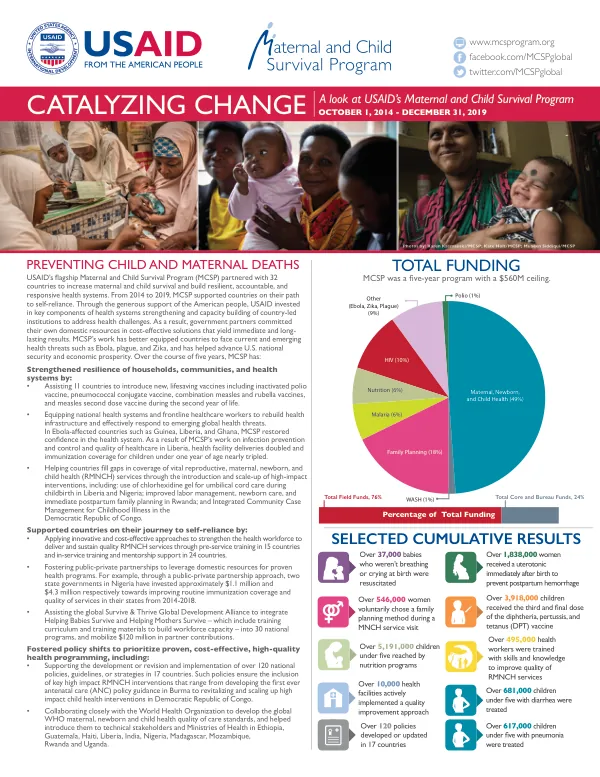
The Maternal and Child Survival Program (MCSP) is a global, $560 million, 5-year cooperative agreement funded by the United States Agency for International Development (USAID) to introduce and support scale-up of high-impact health interventions among USAID's 25 maternal and child health priority countries, as well as other countries.
2019 · 24 pages
Sign in to readA free account is required to download.
Abstract
MCSP is focused on ensuring that all women, newborns, and children most in need have equitable access to quality health care services to save lives. MCSP supports programming in maternal, newborn, and child health, immunization, family planning and reproductive health, nutrition, health systems strengthening, water/sanitation/hygiene, malaria, prevention of mother-to-child transmission of HIV, and pediatric HIV care and treatment. MCSP's WASH program aimed to improve health care facility (HCF) WASH conditions and practices to contribute to quality of care (QoC) improvements and reductions of maternal and newborn infections through MCSP's innovative Clean Clinic Approach. The program leveraged WASH investments to increase access to and use of WASH services at household, community, and HCF levels using low-cost interventions. MCSP's cross-country implementation and research experience informed four key recommendations for future QoC and WASH initiatives. One of the key recommendations is to employ behavior change interventions aimed at improving motivation to practice behaviors. Interventions should not only include awareness-raising and access interventions but also evidence-based interventions aimed at increasing motivation through persuasion, accountability, modeling, and/or incentives. Stakeholders are encouraged to design programs that incorporate WASH and infection prevention and control (IPC) from a systems perspective, with the recognition that behavior change is a critical concern in health care and requires comprehensive interventions to sustain compliance and ensure institutionalization. Another recommendation is to improve WASH monitoring and data use at HCF level. Future data collected should be immediately shared with HCF management and staff to pursue needed action. When HCFs have access to detailed and relevant data, staff can, and do, make many incremental improvements in WASH and infection prevention, even in the absence of external funding and resourcing support. MCSP's experience also highlights the importance of strengthening WASH and infection prevention monitoring within the health system to drive incremental improvements. In addition to measuring outputs, stakeholders at ward, HCF, and health system level should measure outcomes (e.g., reducing contamination, reducing infections, reducing costs, or improving QoC) to support advocacy for increased investments in WASH in HCFs. The program also emphasizes the need to incorporate WASH and IPC collectively as part of sustained quality improvement efforts. WASH and IPC are not standalone challenges; they are fundamental to providing any safe health care service and for ensuring a positive experience of care. WASH and IPC improvement efforts should always be integrated into any quality improvement effort. Furthermore, MCSP's experience suggests that monitoring and strengthening supply chain prioritization and delivery systems is crucial for HCF improvements. Most countries lack systems for monitoring health office performance related to WASH/IPC supply chain and maintenance support. In MCSP's experience, HCF improvements will plateau quickly unless monitoring and accountability systems are applied to district and provincial health offices to ensure the consistent supply of required resources and supplies. Finally, the program advocates for higher prioritization of IPC materials and supplies. With the persistence of health care-associated infections and the emergence of antimicrobial resistance, national health systems must begin to allocate sufficient budget and resources to infection prevention. To achieve and sustain incremental improvements like those achieved under MCSP, it is essential to advocate for the prioritization of IPC supplies and materials within national supply chain systems in a similar way that essential medicines are prioritized.