USAID DEC
Sustainable Landscapes Opportunities Analysis for West Africa: Biophysical Potential
Sign inTETRA TECH
Sustainable Landscapes Opportunities Analysis for West Africa: Biophysical Potential
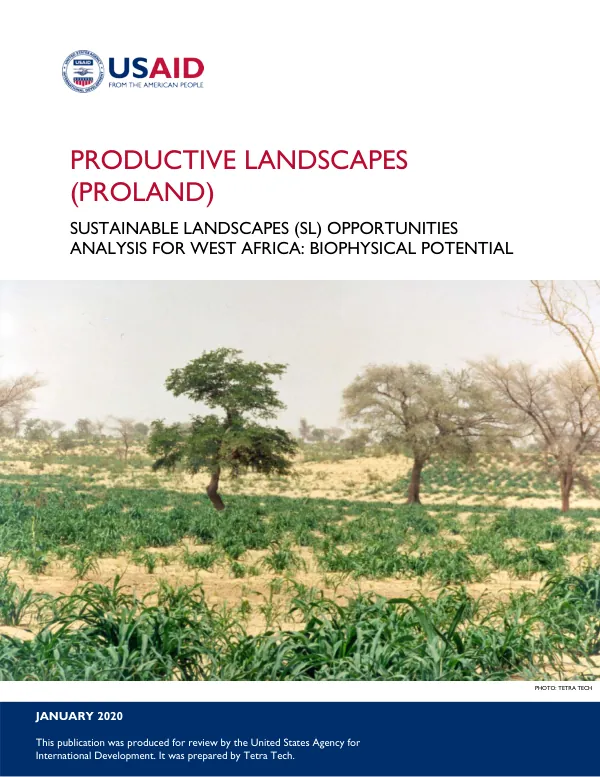
The sustainable landscapes (SL) opportunities analysis for West Africa aims to provide decision support for prioritizing SL investments in the region.
2020 · 37 pages
Sign in to readA free account is required to download.
Abstract
The analysis focuses on 15 countries, including the 14 continental members of the Economic Community of West African States (ECOWAS) plus Cameroon. The document assesses the regional biophysical potential of 20 identified pathways for land-based greenhouse gas (GHG) mitigation. The analysis identifies 14 major pathways for land-based climate mitigation in 15 countries of Western Africa, for which national-scale data is available. These pathways include avoided deforestation, reforestation, trees in agriculture, and improved forest management. The cost-effective potential of these pathways is estimated to be in the millions of tons of CO2e per year. Avoided deforestation is identified as a key pathway for GHG mitigation in West Africa. Forest cover in the region has declined significantly over the past few decades, with deforestation rates varying across countries. The analysis highlights the importance of protecting and restoring forests in West Africa, which could potentially sequester large amounts of carbon dioxide. Reforestation is another critical pathway for GHG mitigation in West Africa. The analysis estimates that widespread or mosaic forest restoration could potentially sequester millions of tons of CO2e per year. The potential for reforestation varies across countries, with some countries having higher potential than others. Trees in agriculture is also identified as a key pathway for GHG mitigation in West Africa. The analysis estimates that trees in agriculture could potentially sequester millions of tons of CO2e per year. The potential for trees in agriculture varies across countries, with some countries having higher potential than others. Improved forest management is another critical pathway for GHG mitigation in West Africa. The analysis highlights the importance of sustainable forest management practices, such as selective logging and reforestation, to maintain forest health and productivity. The analysis also identifies six pathways for land-based climate mitigation that were identified by Griscom et al. (2017) but for which neither of the two Griscom et al. (2017; 2020) studies estimated national-scale potential. These pathways include agroforestry, perennials in agriculture, and urban forestry. The document provides a comprehensive analysis of the biophysical potential of 20 identified pathways for land-based GHG mitigation in West Africa. The analysis highlights the importance of prioritizing SL investments in the region to mitigate climate change. The document is intended to provide decision support for policymakers and practitioners working on SL initiatives in West Africa. The analysis is based on a range of data sources, including national-scale data on forest cover, deforestation rates, and land use patterns. The document also draws on international datasets, such as the Hansen et al. (2013) dataset, which provides global data on forest cover and deforestation rates. The document is organized into several sections, including an introduction, methodology, and results. The introduction provides an overview of the SL opportunities analysis for West Africa and its objectives. The methodology section describes the approach used to estimate the biophysical potential of the 20 identified pathways. The results section presents the findings of the analysis, including the estimated potential of each pathway and the regional biophysical potential of the 20 identified pathways. The document concludes by highlighting the importance of prioritizing SL investments in West Africa to mitigate climate change. The analysis provides a comprehensive framework for decision-making on SL initiatives in the region, taking into account the biophysical potential of different pathways and the regional context.