ACDI/VOCA
Sustainable Nutrition and Agriculture Promotion Annual Results Report FY 2015
The Sustainable Nutrition and Agriculture Promotion (SNAP) program in Sierra Leone was implemented by ACDI/VOCA, with funding from the U.S.
2015 · 23 pages
Sign in to readA free account is required to download.
Abstract
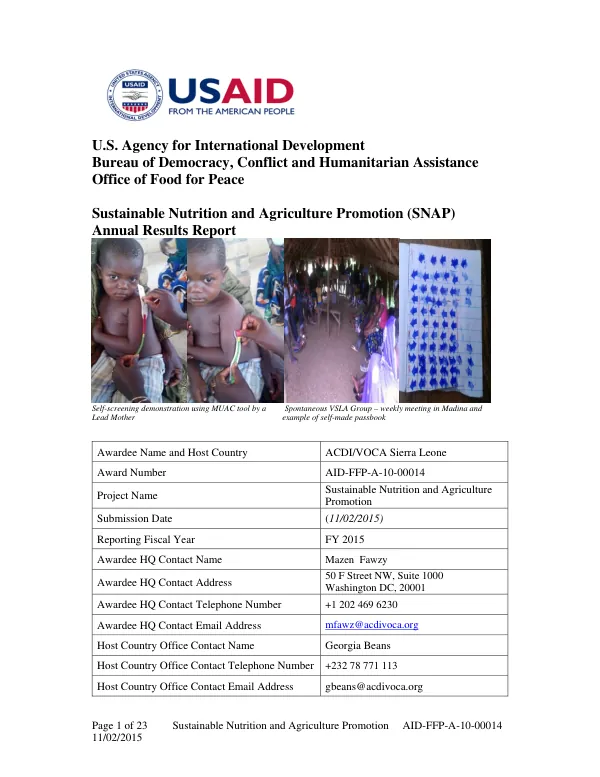
Agency for International Development (USAID). The program aimed to improve access to quality nutrition and health services for women and children under 59 months of age. Due to the Ebola Virus Disease (EVD) outbreak in May 2014, the program's implementation was significantly affected, with many activities suspended or delayed. Strategic Objective 1 (SO1) focused on initiatives to mobilize program beneficiaries to resume standard health-seeking practices and benefit from health and nutrition services at Peripheral Health Units (PHUs). To achieve this, SNAP supported the Ministry of Health to deliver Child Health Immunization Training, which provided comprehensive guidelines to health workers for the treatment of childhood illnesses in the context of EVD. The training also supported the resumption of immunization, vitamin A, and growth monitoring campaigns. SNAP also supported the District Health Management Team (DHMT) to facilitate Reproductive Health (RH) and Family Planning (FP) training to improve knowledge, attitude, and practice of health professionals in counseling on sexual reproductive health and family planning. Additionally, International Medical Corps delivered training on Growth Monitoring and Promotion (GMP) to enhance knowledge and correct use of anthropometric tools and documentation of growth records. The program's efforts to improve access to quality nutrition and health services were hindered by the EVD outbreak, which led to a decline in trust in health facilities and a shortage of health workers. To address this, SNAP organized orientation on EVD for PHU staff to facilitate better understanding of the virus's mode of transmission and to protect health workers on the job. Staff were also sensitized on the effective and persistent use of basic protective wear while taking care of the sick. Capacity building and coaching on data gathering and reporting were also provided to DHMT during joint supportive supervision visits. Over 80% of 123 PHUs were covered in each quarter to ensure that standard service delivery parameters were attained. The gaps in anthropometric tools were identified during the supportive supervision, and SNAP will ensure that tools are provided and utilized for growth monitoring and nutrition assessment. The program's activities were gradually reinstated between Quarters 3 to 4 of FY15, with a focus on reinforcing best practices, integrating output from the mid-term evaluation, and solidifying sustainability strategies and approaches. The program also observed the emergence of spontaneous Village Savings and Loans Associations (VSLAs) due to the effective establishment and performance of groups throughout the program. Strategic Objective 2 (SO2) program activities focused on continued technical support to farming clusters, enabling minimal sales at the local level and participation in the Purchase for Progress (P4P) program in partnership with the World Food Program (WFP) to support Ebola food distribution. The program also supported second planting seed cultivation for mother care group vegetable gardens in December 2014 to restart activities that were essentially abandoned due to the EVD impacts during Quarter 1. The program's efforts to promote commercial agricultural production were constrained by the EVD outbreak, but the program continued to support farming clusters and promote agricultural production in the constrained conditions. The program also observed the emergence of spontaneous VSLAs, which were established and performed effectively throughout the program. The program's activities were affected by the EVD outbreak, but the program continued to maintain a minimal presence in the communities and most activities were reactivated toward the end of FY15 as the incidence of new EVD cases reduced. The program's efforts to improve access to quality nutrition and health services were hindered by the EVD outbreak, but the program continued to support the Ministry of Health and the District Health Management Team to deliver training and provide technical support to health facilities.
Related documents