USAID DEC
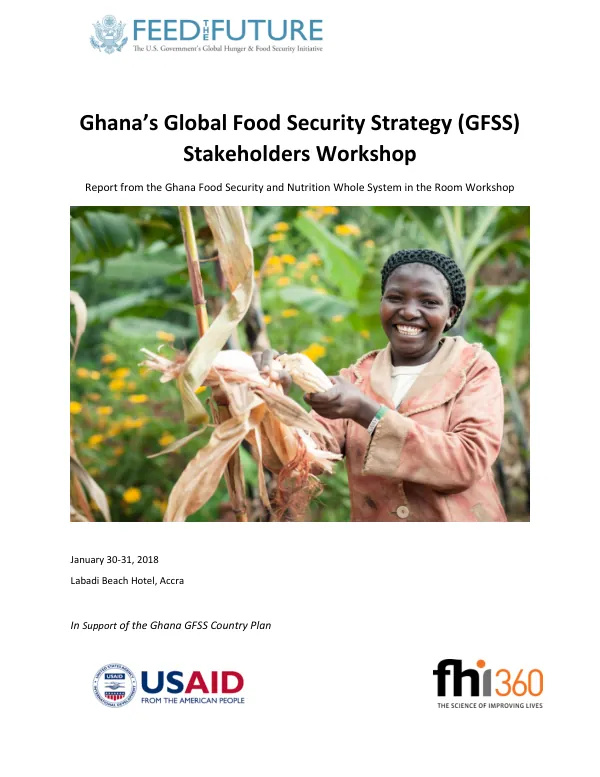
Ghana’s Global Food Security Strategy (GFSS) Stakeholders Workshop | Whole System in the Room | January 2018
Sign inDAI
Ghana’s Global Food Security Strategy (GFSS) Stakeholders Workshop | Whole System in the Room | January 2018
Ghana's Global Food Security Strategy (GFSS) Stakeholders Workshop was convened by USAID on January 30-31, 2018, at the Labadi Beach Hotel in Accra.
2018 · 25 pages
Sign in to readA free account is required to download.
Abstract
The workshop aimed to create a common vision and action agenda for improved food security and nutrition in Ghana. A total of 132 participants from nine diverse food security and nutrition stakeholder groups attended the workshop. The workshop utilized FHI 360's Whole System in the Room (WSR) methodology, which involves deconstructing the shared history of stakeholders, examining key trends affecting food security and nutrition, and envisioning a future scenario. The participants, comprising leaders from Ghanaian agriculture businesses, government, smallholder farmers and fishers, and professional specialists within civil society, NGOs, and research institutions, created and agreed to a common set of goals and priority actions. The key challenges facing Ghana in terms of food security and nutrition include poverty, malnutrition, and regional disparities. Despite progress in poverty reduction, almost a quarter of Ghanaians still live below the poverty line. The northern region has a poverty rate nearly twice that of the south. Ghana is a focus country for Feed the Future, and the initiative is contributing to the government's commitment to food security. The workshop participants committed to seven key actions: strengthening the market system, improving nutrition for all Ghanaians, increasing women and youth empowerment, ensuring access to financing, strengthening and enforcing policy, increasing access to agricultural technologies, and generating and applying knowledge. These actions are aligned with the Government of Ghana's objectives of poverty reduction, food security, sustainable management, and conservation. The workshop was made possible by the generous support of the American people through the United States Department of State and the United States Agency for International Development (USAID). The contents of the workshop report are the responsibility of FHI 360 and do not necessarily reflect the views of USAID or the United States Government. The workshop's outcomes and recommendations are presented in the report, which includes a list of acronyms, an executive summary, a workshop summary, background and methodology, and annexes containing key ideas emerging from participants, common ground statements, stakeholder group action plans, additional voices, and a workshop agenda. The report highlights the importance of a holistic, multi-sectoral approach to addressing the complex and interconnected nature of hunger, malnutrition, and poverty facing Ghana. The workshop's outcomes and recommendations provide a framework for stakeholders to work together towards a common vision of improved food security and nutrition in Ghana.