USAID DEC
Sustaining Biodiversity Conservation in and around Nyungwe National Park Environmental Monitoring & Mitigation Plan
Sign inWORLD WILDLIFE FUND INTERNATIONAL
Sustaining Biodiversity Conservation in and around Nyungwe National Park Environmental Monitoring & Mitigation Plan
The Rwanda Development Board (RDB) aims to improve the capacity of the RDB to sustainably manage Nyungwe National Park's resources and address specific threats to the park and specific species of concern.
2012 · 16 pages
Sign in to readA free account is required to download.
Abstract
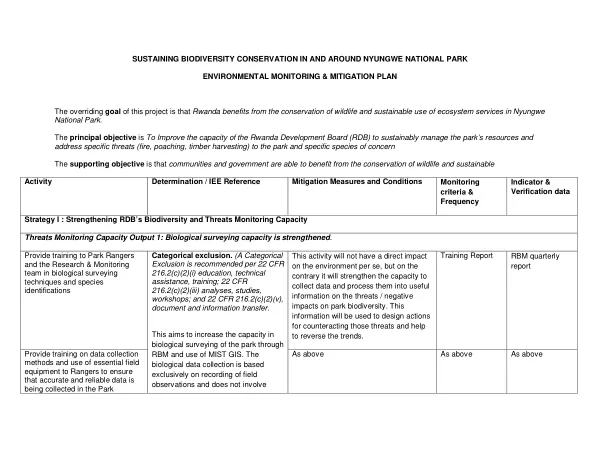
The principal objective is to strengthen the RDB's biodiversity and threats monitoring capacity, improve law enforcement and threat monitoring and assessment, and enhance the capacity to monitor and model climate. To achieve this objective, the RDB will provide training to Park Rangers and the Research & Monitoring team in biological surveying techniques and species identification. This will increase the capacity in biological surveying of the park through the use of RBM and MIST GIS. The biological data collection is based exclusively on recording of field observations and does not involve the collection of any biological specimen or material. The RDB will also provide training on data collection methods and use of essential field equipment to Rangers to ensure that accurate and reliable data is being collected in the Park. Additionally, the Research & Monitoring team will be trained in data analysis and management, and deliver additional GIS training enabling the RDB to carry out more advanced data analysis and assessment of biodiversity in the Park. Furthermore, the RDB will strengthen its capacity to monitor and model climate by holding a workshop for scenario-building to share the climate and landscape modeling output from the WCS Albertine Rift climate assessment. The RDB will also hold training to build capacity to monitor climate impacts and carry out needs assessment for field equipment and initiate the process to acquire the identified equipment. To address conflicts and mitigate threats, the RDB will establish a partnership with the International Institute of Sustainable Development (IISD) to build capacity to understand, manage, and resolve conflicts. The RDB will also develop a conflict resolution taskforce to implement and maintain dialogue with the Sector groups and hold regular training sessions and meetings between the taskforce and community members in conflict areas. The RDB will also construct two new ranger posts to aid in Park patrols, which will be conducted in a manner consistent with good design and implementation practices described in EGSSAA Chapter 4: ecotourism. Environmental assessments (EAs) or detailed mitigation strategies will be carried out to avoid or mitigate adverse impacts on tropical forest, biodiversity, and/or threatened and endangered species. The RDB will use an environmental screening and review process for all the steps for the patrol post construction and occupation using impact assessment tools to screen the activities, develop mitigation measures, and specify monitoring and reporting requirements. The RDB will also adapt this process from the environmental Review Form (ERF) and Environmental Review Report (ERR) process. The RDB will monitor and report on the implementation of the environmental mitigation and monitoring actions through activity/task reports, summarized in quarterly reports, site trip reports, EMMP summary reports, and annual reports. The RDB will also ensure that the construction activities result in no adverse environmental impact and that the mitigation measures are implemented as necessary.