USAID DEC
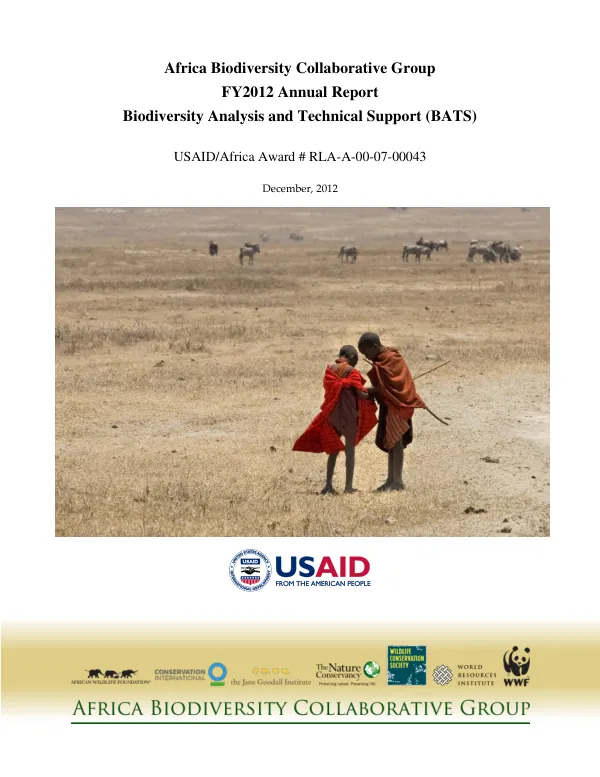
FY2012 Annual Report for the Biodiversity Analysis and Technical Support (BATS) Program, USAID/AFR
Sign inAFRICAN BIODIVERSITY COLLABORATIVE GROUP
FY2012 Annual Report for the Biodiversity Analysis and Technical Support (BATS) Program, USAID/AFR
The Africa Biodiversity Collaborative Group (ABCG) is a coalition of major US-based international conservation non-governmental organizations (NGOs) with field-based activities in Africa.
2012 · 71 pages
Sign in to readA free account is required to download.
Abstract
The group's mission is to tackle complex and changing conservation challenges by catalyzing and strengthening collaboration, and bringing the best resources from across a continuum of conservation organizations to effectively and efficiently work towards a vision of an African continent where natural resources and biodiversity are securely conserved in balance with sustained human livelihoods. ABCG's objectives are to promote networking, awareness, information sharing and experience among U.S. conservation NGOs working in Africa, to identify and analyze critical and/or emerging conservation issues in Africa as priorities for both future NGO action and donor support, and to synthesize collective lessons from field activities and share them with a broader multi-sector community in the United States and Africa. The BATS program, funded by the US Agency for International Development's (USAID) Biodiversity Analysis and Technical Support (BATS) program, is a multi-partner effort that includes International Resources Group (IRG), the USDA Forest Service International Programs, Environmental Law Institute (ELI), the Capitalizing Knowledge, Connecting Communities (CK2C) project of Development Alternatives, Incorporated (DAI), and the Africa Biodiversity Collaborative Group (ABCG). The program aims to develop practical documentation of USAID's biodiversity conservation experience and resulting best practices and policy considerations, describe extractive industries partnerships with conservation initiatives, provide technical assistance for biodiversity conservation programs in conflict and crisis states, and highlight governance issues. Task A of the BATS program focused on the Dar Vision for the Future of Biodiversity in Africa, which involved developing a comprehensive framework for biodiversity conservation in Africa. The task involved conducting a thorough analysis of the current state of biodiversity in Africa, identifying key threats and opportunities, and developing a set of recommendations for policymakers and practitioners. Task B of the BATS program focused on managing extractive industries to protect biodiversity. This task involved conducting a comprehensive assessment of the impact of extractive industries on biodiversity in the Democratic Republic of Congo (DRC), and developing a set of recommendations for policymakers and practitioners on how to manage extractive industries in a way that minimizes their impact on biodiversity. Task C of the BATS program focused on land use management tools for conservation. This task involved developing a set of tools and methodologies for managing land use in a way that balances human needs with biodiversity conservation. The task involved conducting a thorough analysis of the current state of land use in Africa, identifying key challenges and opportunities, and developing a set of recommendations for policymakers and practitioners. Task D of the BATS program focused on support for country 118/119 tropical forestry and biodiversity assessments. This task involved conducting a comprehensive assessment of the state of tropical forestry and biodiversity in a set of countries in Africa, and developing a set of recommendations for policymakers and practitioners on how to manage tropical forests in a way that balances human needs with biodiversity conservation. Task E of the BATS program focused on food security. This task involved conducting a comprehensive assessment of the impact of biodiversity conservation on food security in Africa, and developing a set of recommendations for policymakers and practitioners on how to balance human needs with biodiversity conservation. Task F of the BATS program focused on addressing global climate change through adaptation and actions in woodlands, grasslands, and other ecosystems. This task involved conducting a comprehensive assessment of the impact of climate change on biodiversity in Africa, and developing a set of recommendations for policymakers and practitioners on how to adapt to climate change in a way that balances human needs with biodiversity conservation. Task G of the BATS program focused on bridging the gap between global health and biodiversity. This task involved conducting a comprehensive assessment of the impact of biodiversity conservation on global health in Africa, and developing a set of recommendations for policymakers and practitioners on how to balance human health needs with biodiversity conservation. Task H of the BATS program focused on forecasting and analyzing conservation needs and building capacity on critical issues. This task involved conducting a comprehensive assessment of the current state of conservation in Africa, identifying key challenges and opportunities, and developing a set of recommendations for policymakers and practitioners on how to build capacity and address critical issues in conservation. The BATS program also included a number of outreach and communication activities, including the development of a website and social media presence, and the production of a number of reports and publications on biodiversity conservation in Africa.