USAID. MISSION TO SWAZILAND
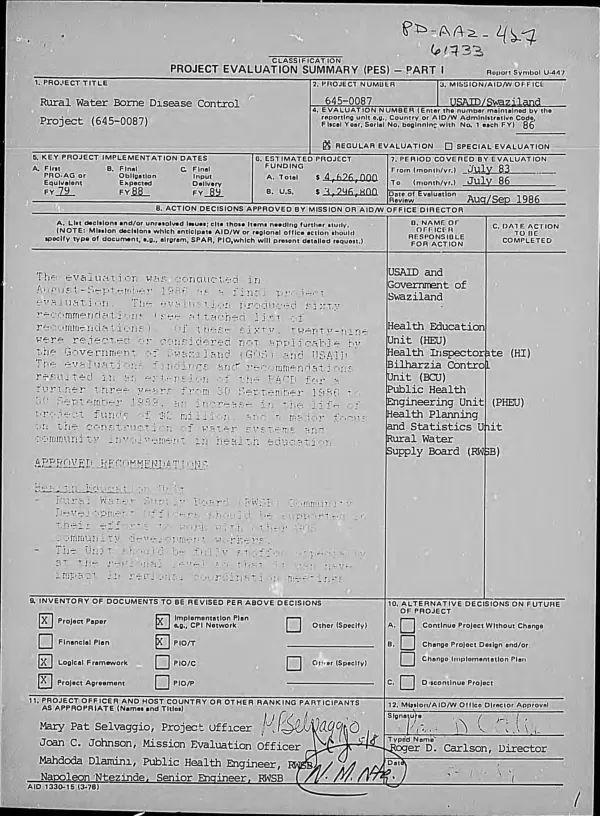
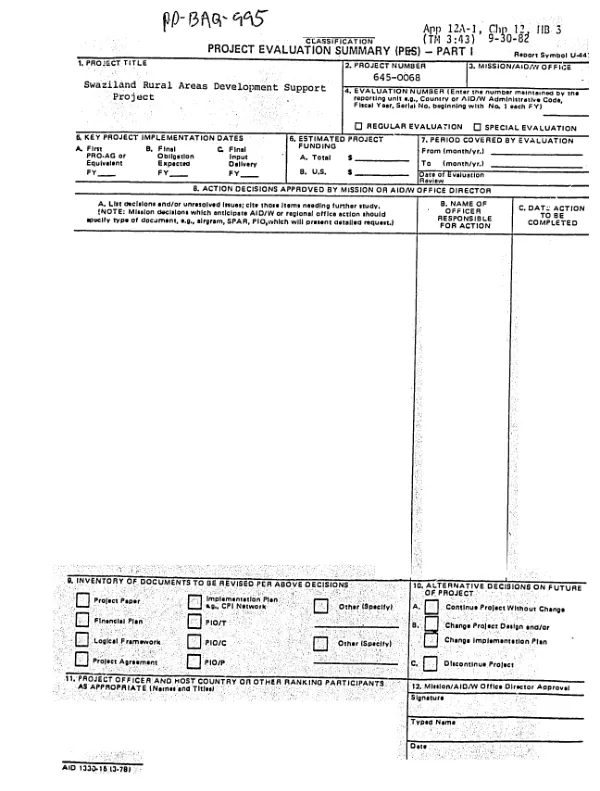
Swaziland rural areas development support project
Evaluates project to help the Government of Swaziland (GOS) implement its Rural Development Area (RDA) program for homesteaders on Swazi Nation Land by undertaking conservation works and by strengthening the Land Use Planning Section (LUPS) and the Land Development Section (LDS) of the Ministry of Agriculture and Cooperatives.
1970
Sign in to readA free account is required to download.
Abstract
PES covers 1979-8/83 and summarizes an attached external evaluation (XD-BAQ-995-A). Although the project has progressed otherwise than planned, the RDA program is a sound development strategy and should be extended. Because erosion was not as serious as anticipated, only 5,033 of a targeted 80,350 acres of terraces and grass strips have been rehabilitated. Instead, the project has responded to RDA homesteaders" priorities and has built 1,900 km of access road, 4,693 level homesites, and 30 domestic water supply systems (the latter serving 67,500 persons). Unplanned effects include better living standards, deeper political and economic involvement by the people, decreased infant mortality, and improved school attendance. Institution-building activities for the LUPS are at least 2 years behind schedule because of USAID/S"s delay in fielding TA and GOS delays in assigning personnel and trainees. To date, 6 Swazi"s are in U.S. graduate programs, only 1 has returned, and several positions still lack candidates. LDS training has been more successful; 34 trained mechanics and 135 certified heavy equipment operators are on board, and over 200 personnel attended an LDS maintenance workshop. Land use plans for the first 4 RDA"s have been published (these are yet to be completed for the remaining RDA"s), as have improved management procedures for planning/constructing infrastructure. Lessons learned are: (1) a project will be "sold short" if its objectives are defined too narrowly and its verifiable indicators are inadequate measures of success; (2) TA for institution building should support a total program rather than be restricted in its sphere of influence; (3) great care is needed in setting realistic targets; (4) beneficiaries need to be deeply involved in project planning; and (5) USAID should be more careful in selecting contractors.