USAID. MISSION TO SWAZILAND
Swaziland training and institutional development
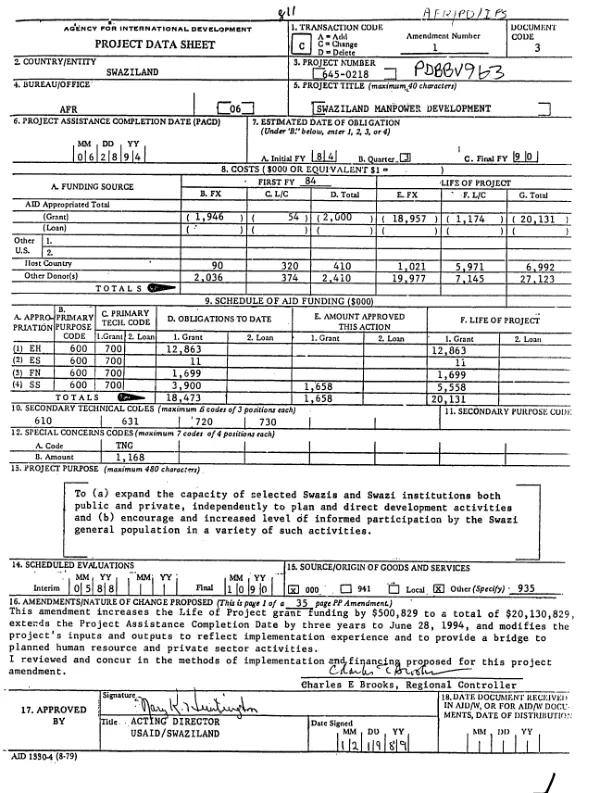
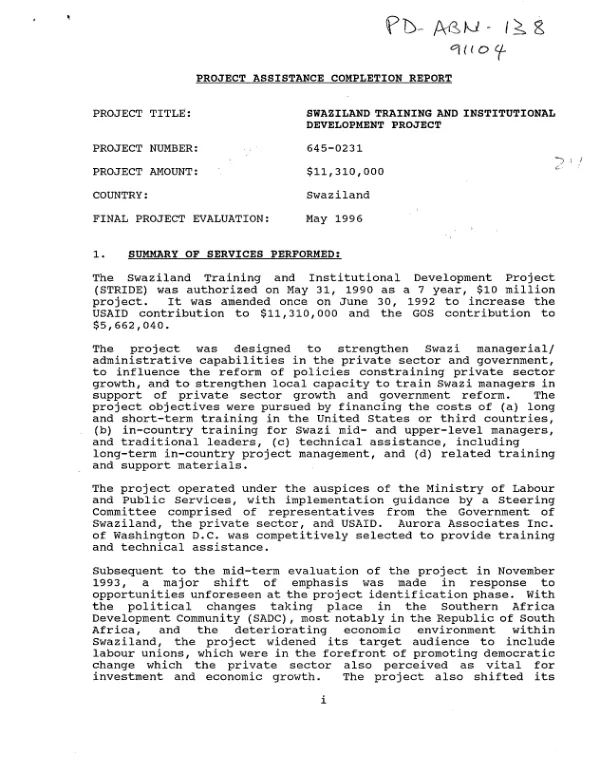
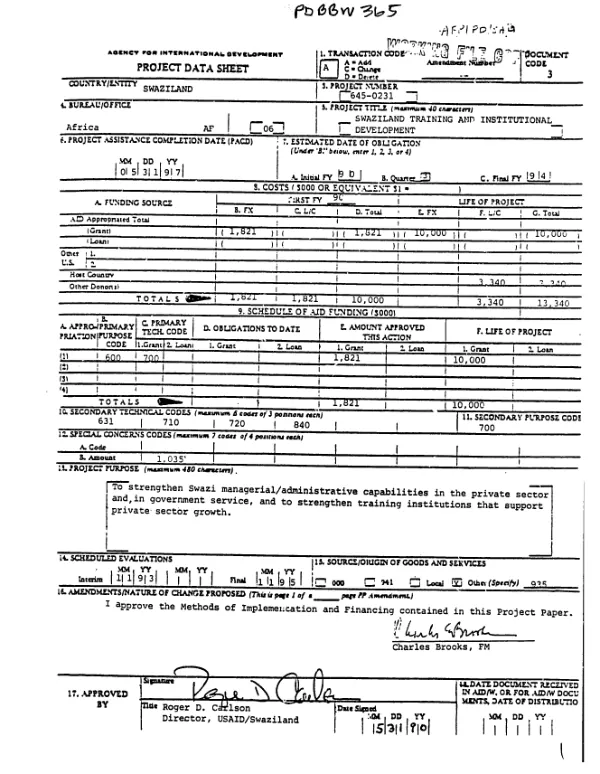
Project, follow-on to 6450218, to strengthen managerial capabilities in Swaziland"s private and public sectors by: (1) training managers and administrators, (2) strengthening university programs, and (3) strengthening policy implementation.
1990
Sign in to readA free account is required to download.
Abstract
Managerial training will be both external and in-country. External training will include U.S. academic scholarships for 42 participants, including 6 B.A."s, 32 M.A"s, and 4 Ph.D."s, the latter for University of Swaziland (UNISWA) faculty. At least 33% of the scholarships will go to private sector candidates, and 35% to women. Additionally, 40 participants, half from the private sector, will receive short-term external training. In- country short-term training will be provided to 660 participants in such areas as financial management, personnel supervision, and strategic planning. Assistance to tertiary training institutions will focus on UNISWA and the Swaziland College of Technology (SCOT). The project will contract a U.S. university to establish linkages with the business/accounting programs of both universities. The linkage will help UNISWA modify curricula, develop new courses, identify instructional materials (textbooks, computer software), and adapt courses to private sector needs. The linkage with SCOT will help it to upgrade faculty quality, expand curricula, and obtain computers. Peace Corps volunteers will replace SCOT faculty who are away on training. The project will strengthen implementation of Swaziland"s economic policies, already geared to the private sector, in two ways. (1) The project will improve administrative efficiency by providing 16 person-months each of short-term TA and local consultancies for selected Government of Swaziland (GOS) institutions. Possible interventions include helping the Ministry of Finance to improve budget management and the Ministry of Works to manage construction contracts with private firms. (2) The Community Development Department (CDD) of the Tinkhundla, the GOS Ministry responsible for local training, will build on training provided under project -0218 by training community leaders in areas such as local business development, community participation in development projects, financial management, and other administrative skills. Two types of leaders will be trained: traditional leaders, such as chiefs and their subordinates; and officers of community development committees. CDD staff will themselves receive training in the areas noted above. Amendment of 6/15/92 increases the number of Masters" degrees provided through the Thomas Jefferson Fellowship Program from 32 to 44. The main purpose of the amendment is to allow USAID/S to continue the Fellowship program through 1995. (PD-ABE-797)
Related documents