CARE
Takunda Resilience Food Security Activity: Agriculture Value Chain Analysis
The Takunda Resilience Food Security Activity is a study conducted by Sydney Zharare, Godfrey Mudimu, Kingstone Mujeyi, Collen Matema, Alex Popi, and Nyasha Chitaka, and submitted on December 13, 2021.
2021 · 105 pages
Sign in to readA free account is required to download.
Abstract
The study aims to analyze the agriculture value chain in Zimbabwe, with a focus on identifying constraints and opportunities for improvement. The study identifies four value chains for in-depth analysis: sorghum, groundnuts, cowpeas, and indigenous chickens. The analysis of each value chain includes an examination of the core value chain, supporting functions, and policy and regulatory functions. The study finds that farmers' current value chain preferences are influenced by factors such as market access, input availability, and output prices. The study also identifies several constraints and opportunities for improvement in each value chain. For example, in the sorghum value chain, the study finds that farmers face challenges related to market access and input availability, while in the groundnuts value chain, the study identifies opportunities for improvement in the processing and marketing of groundnuts. The study recommends several interventions to address the constraints and opportunities identified in each value chain. For example, the study recommends the establishment of a sorghum processing facility to improve market access for farmers, while in the groundnuts value chain, the study recommends the development of a groundnut processing and marketing strategy to increase farmers' incomes. The study's findings and recommendations are based on a comprehensive analysis of the agriculture value chain in Zimbabwe, including a review of existing literature and data collection from farmers and other stakeholders. The study's methodology includes a value chain analysis and program design exercise, which involved the selection of value chains for in-depth analysis and the identification of factors influencing farmers' current value chain preferences. The study's results have implications for the Takunda Resilience Food Security Activity, which aims to improve food security and resilience in Zimbabwe. The study's findings and recommendations can inform the design and implementation of interventions to address the constraints and opportunities identified in each value chain, ultimately contributing to improved food security and resilience for farmers and communities in Zimbabwe. The study's analysis of the sorghum value chain highlights the importance of market access and input availability for farmers. The study finds that farmers face challenges related to market access, including limited access to markets and high transportation costs. The study also identifies opportunities for improvement in the processing and marketing of sorghum, including the establishment of a sorghum processing facility to improve market access for farmers. In the groundnuts value chain, the study identifies opportunities for improvement in the processing and marketing of groundnuts. The study finds that farmers face challenges related to market access and input availability, while also identifying opportunities for improvement in the processing and marketing of groundnuts. The study recommends the development of a groundnut processing and marketing strategy to increase farmers' incomes. The study's analysis of the cowpeas value chain highlights the importance of policy and regulatory functions for farmers. The study finds that farmers face challenges related to policy and regulatory functions, including limited access to credit and input subsidies. The study also identifies opportunities for improvement in the cowpeas value chain, including the development of a cowpeas processing and marketing strategy to increase farmers' incomes. In the indigenous chickens value chain, the study identifies opportunities for improvement in the processing and marketing of indigenous chickens. The study finds that farmers face challenges related to market access and input availability, while also identifying opportunities for improvement in the processing and marketing of indigenous chickens. The study recommends the development of an indigenous chickens processing and marketing strategy to increase farmers' incomes. Overall, the study's findings and recommendations have implications for the Takunda Resilience Food Security Activity, which aims to improve food security and resilience in Zimbabwe. The study's analysis of the agriculture value chain in Zimbabwe provides a comprehensive understanding of the constraints and opportunities facing farmers and communities, and informs the design and implementation of interventions to address these challenges.
Related documents
Documents in this collection
 2012
2012USAID DEC
Climate Change Impact on Agricultural Production and Adaptation Strategies: Farmers’ Perception and Experiences Summary Results of Focus Group Interviews in Zambia, 2012
Open record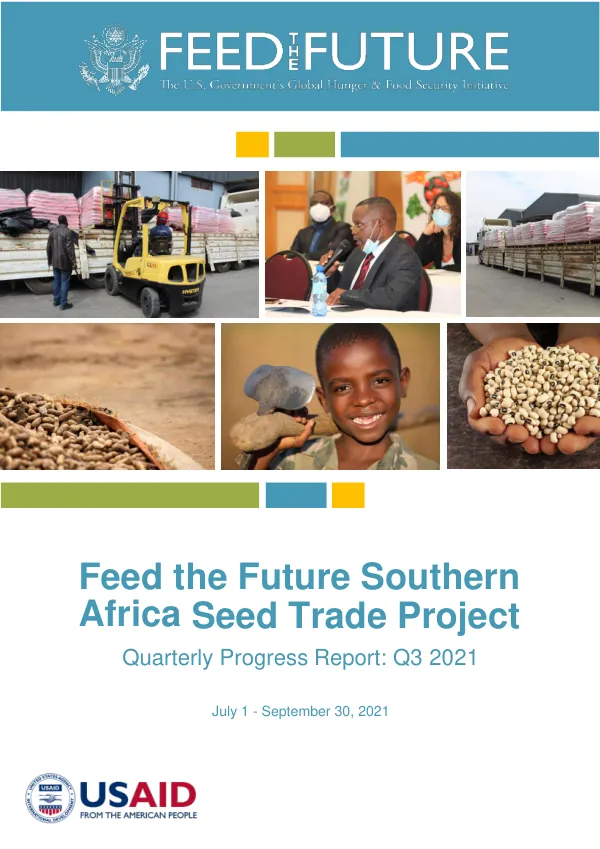 2021
2021USAID DEC
Feed the Future Southern Africa Seed Trade Project Quarterly Progress Report: Q3 2021
Open record