USAID DEC
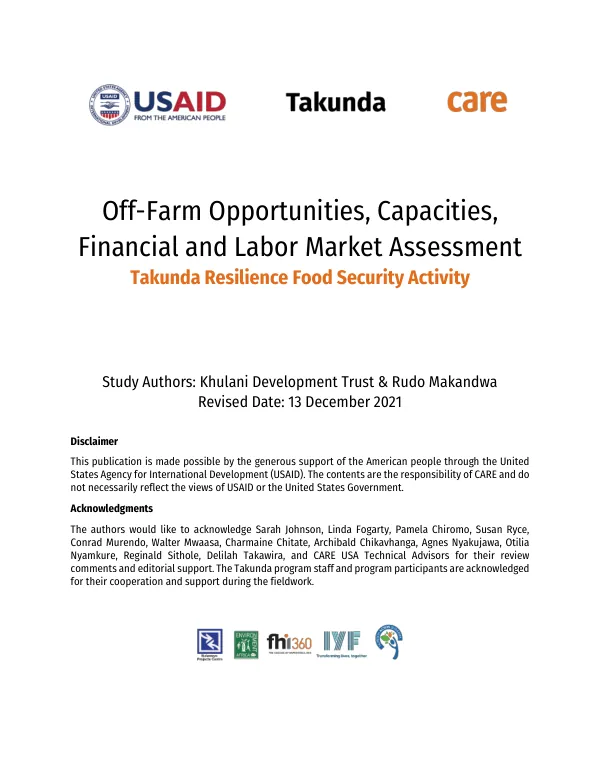
Off-Farm Opportunities, Capacities, Financial and Labor Market Assessment for Takunda Resilience Food Security Activity
Sign inCARE
Off-Farm Opportunities, Capacities, Financial and Labor Market Assessment for Takunda Resilience Food Security Activity
The Takunda Resilience Food Security Activity is a program aimed at improving the economic opportunities and well-being of young people in Zimbabwe.
2021 · 103 pages
Sign in to readA free account is required to download.
Abstract
The program is supported by the United States Agency for International Development (USAID) and is implemented by CARE. The study, conducted by Khulani Development Trust and Rudo Makandwa, assesses the off-farm opportunities, capacities, financial, and labor market for young people in the Takunda areas. The study's objectives are to identify the economic opportunities and access to off-farm income, financial inclusion, labor supply and demand alignment, youth wellbeing, agency, and engagement, and youth migration. The study's methodology involves a combination of quantitative and qualitative approaches, including surveys, focus group discussions, and key informant interviews. The study's results indicate that young people in the Takunda areas face significant challenges in accessing employment and improving their livelihoods. The study identifies emerging opportunities in various sectors, including agriculture, manufacturing, and services. The study's findings suggest that young people in the Takunda areas have limited access to formal financial services, and those who do have access often face high costs and limited product customization. The study recommends increasing access to financial services, improving labor supply and demand alignment, and enhancing youth wellbeing, agency, and engagement. The study also identifies the need for training and capacity building for young people, particularly in areas such as entrepreneurship, financial literacy, and vocational skills. The study suggests that building institutional capacity, conducting research and learning, and advocating for policy changes are essential for improving the economic opportunities and well-being of young people in the Takunda areas. The study's results are presented in various tables and figures, which provide a detailed analysis of the economic opportunities and challenges faced by young people in the Takunda areas. The study's recommendations provide a roadmap for policymakers, program implementers, and stakeholders to improve the economic opportunities and well-being of young people in the Takunda areas. The study's findings have significant implications for the development of policies and programs aimed at improving the economic opportunities and well-being of young people in Zimbabwe. The study's recommendations provide a framework for addressing the challenges faced by young people in the Takunda areas and improving their access to economic opportunities. The study's results indicate that young people in the Takunda areas have limited access to employment and income-generating opportunities. The study identifies emerging opportunities in various sectors, including agriculture, manufacturing, and services. The study recommends increasing access to financial services, improving labor supply and demand alignment, and enhancing youth wellbeing, agency, and engagement. The study's findings suggest that young people in the Takunda areas face significant challenges in accessing employment and improving their livelihoods. The study identifies emerging opportunities in various sectors, including agriculture, manufacturing, and services. The study recommends increasing access to financial services, improving labor supply and demand alignment, and enhancing youth wellbeing, agency, and engagement.
Related documents