USAID DEC
Climate Change Impact on Agricultural Production and Adaptation Strategies: Farmers’ Perception and Experiences Summary Results of Focus Group Interviews in Zambia, 2012
Sign inNATIONAL AGRICULTURE INSTITUTE
Climate Change Impact on Agricultural Production and Adaptation Strategies: Farmers’ Perception and Experiences Summary Results of Focus Group Interviews in Zambia, 2012
Climate change has a significant impact on agricultural production in Zambia, with farmers observing changes in rainfall and temperature patterns.
2012 · 5 pages
Sign in to readA free account is required to download.
Abstract
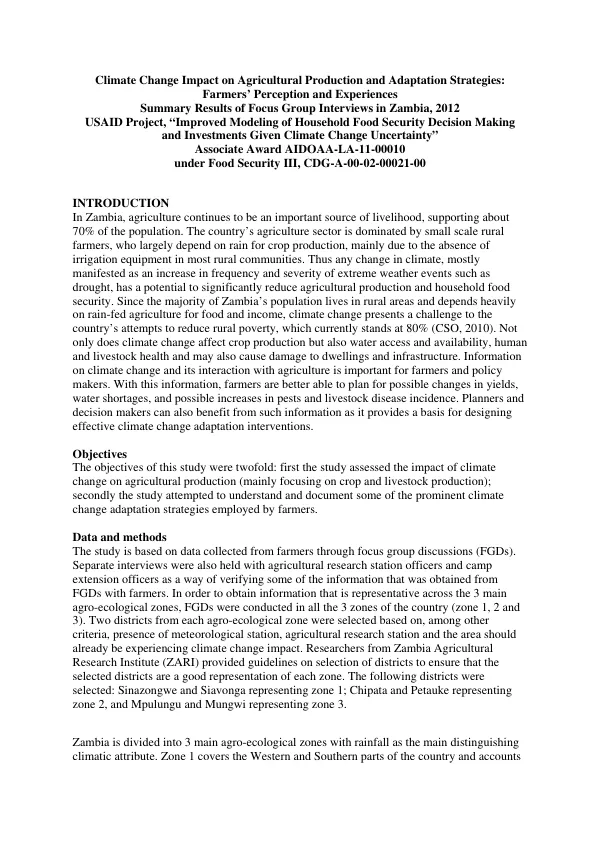
The country's agriculture sector is dominated by small-scale rural farmers who largely depend on rain for crop production. The majority of Zambia's population lives in rural areas and depends heavily on rain-fed agriculture for food and income. Farmers in all six districts, representing the three major agro-ecological zones, are aware that climate is changing mainly through observation of rainfall and temperature trends over a long period of time. Rainfall and temperature patterns have become unpredictable and difficult to define compared to the past. The onset of the rains is now late in the year, ranging from mid-November to mid-December, and the offset is earlier in March compared to April or May in the past. Rainfall amounts have changed, with some areas receiving as little as 600 mm of annual rainfall as opposed to 800 mm before the 1990s. The decline in rainfall amounts has more devastating effects on zone 1 and 2, mainly because these zones have traditionally been receiving just about the normal rainfall amounts. Zone 3, being a traditionally high rainfall area, still receives sufficient rainfall to support rain-fed agriculture despite the general decline in rainfall amounts. The rainfall pattern has become more variable with increasing frequency and severity of intra-seasonal droughts and increasing differences across different geographical locations within the zone, even within the same district. Intra-seasonal droughts are very damaging to crops, especially maize, because they usually set in between January and February, a period when the crop requires sufficient and consistent supply of moisture for flowering and silking. Declining crop yields, especially maize, is one of the recurring themes with regard to climate change impact. Farmers have observed a significant decline in maize productivity, with one farmer explaining that maize productivity was reasonable before 1999 but has declined by about 80% within a period of 12 years. Climate change has also led to an increase in the disease burdens for cattle, goats, and chickens, with farmers explaining that lately, the burden of livestock diseases has become a major issue because of increasing temperatures and reduced rainfall. Farmers in zone 1 have reported that the drying up of streams has affected livestock production because now farmers have to walk their livestock long distances to drink water. This results in reduced live-weight overtime, because the animals expend most of their energy walking instead of gaining weight. This is a major source of concern in zone 1, where most of the streams around villages dry up barely 2 months after the offset of the rains. Farmers have employed various climate change adaptation strategies, including crop diversification, conservation agriculture, and irrigation. However, these strategies have faced implementation barriers due to lack of resources, infrastructure, and knowledge. The study highlights the need for policymakers and extension services to support farmers in adapting to climate change by providing them with the necessary resources, knowledge, and infrastructure to implement climate-resilient agricultural practices. The study's findings have implications for policymakers and extension services in Zambia, highlighting the need to develop and implement climate-resilient agricultural practices that take into account the changing climate conditions. The study also highlights the importance of supporting farmers in adapting to climate change by providing them with the necessary resources, knowledge, and infrastructure to implement climate-resilient agricultural practices.
Related documents