FHI 360
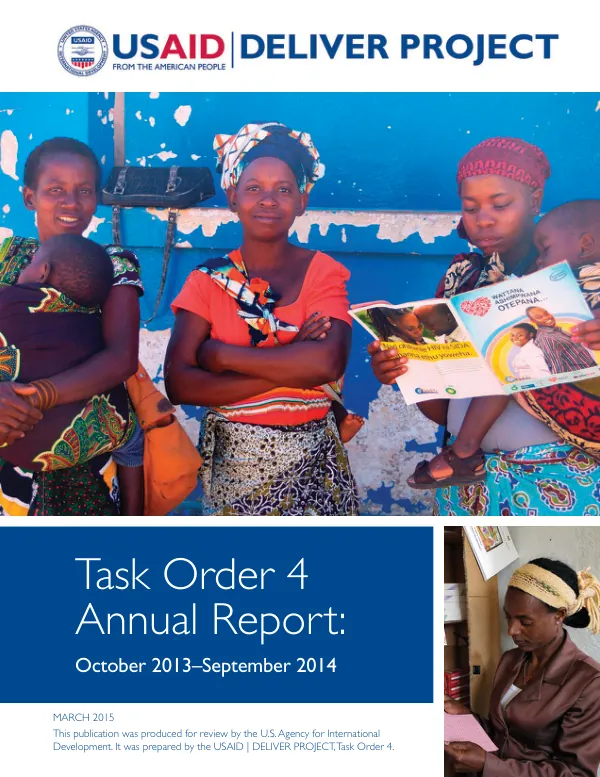
Task Order 4 Annual Report: October 2013–September 2014 (March 2015)
The USAID | DELIVER PROJECT, Task Order 4, is a project funded by the U.S.
2015 · 90 pages
Sign in to readA free account is required to download.
Abstract
Agency for International Development (USAID) to improve essential health commodity supply chains in developing countries. The project is implemented by John Snow, Inc., in collaboration with several partner organizations. The project's main goal is to strengthen logistics management information systems, streamline distribution systems, identify financial resources for procurement and supply chain operation, and enhance forecasting and procurement planning. The project focuses on improving the lives of men, women, and families by strengthening the supply chains that deliver health commodities, developing sustainable national capacity and ownership for operating the supply chain, and cultivating enabling environments for contraceptive security. The project works in several countries, including Mozambique, Ethiopia, and Tanzania, among others. One of the key strategies of the project is to strengthen key supply chain functions, including procurement, logistics, and distribution. The project has implemented several interventions to improve the efficiency and effectiveness of these functions, including the development of a supply chain strategy, system analysis and design, and data visibility and logistics management information systems. The project has also focused on building sustainable national capacity and supporting national ownership. This includes providing training and technical assistance to national stakeholders, including government officials, health workers, and private sector partners. The project has also established partnerships with regional training institutes to extend supply chain capacity building reach. In addition to strengthening supply chain functions and building national capacity, the project has also focused on improving commodity security through data-driven policy, advocacy, and planning. This includes providing technical assistance to national stakeholders to develop and implement policies and plans to improve commodity security. The project has also worked to improve financial tracking and advocacy for funding commodities and supply chains. The project has made significant progress in improving supply chain efficiency and effectiveness, including a 27% increase in household income among program participants compared to the control group. The project has also made significant progress in building local capacity, including training over 2,500 health workers in supply chain management and logistics. The project has also established partnerships with regional training institutes to extend supply chain capacity building reach. In conclusion, the USAID | DELIVER PROJECT, Task Order 4, has made significant progress in improving essential health commodity supply chains in developing countries. The project has strengthened key supply chain functions, built sustainable national capacity, and improved commodity security through data-driven policy, advocacy, and planning. The project's progress has improved the lives of men, women, and families by strengthening the supply chains that deliver health commodities.