USAID DEC
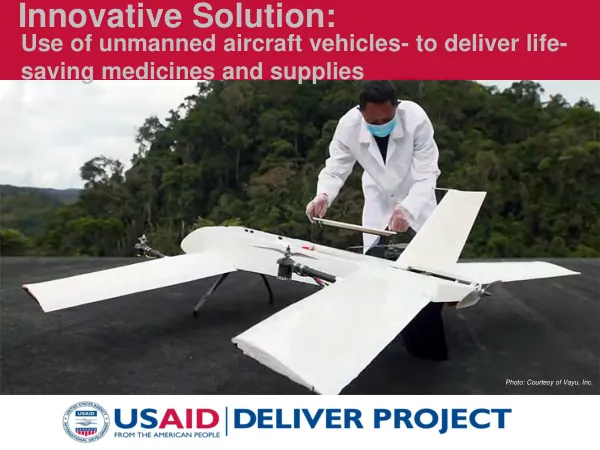
Innovative Solution: Use of unmanned aircraft vehicles- to deliver life-saving medicines and supplies
Sign inCROWN AGENTS – USA
Innovative Solution: Use of unmanned aircraft vehicles- to deliver life-saving medicines and supplies
The use of unmanned aerial vehicles (UAVs) to deliver life-saving medicines and supplies is an innovative solution being explored by the global public health community.
2016 · 34 pages
Sign in to readA free account is required to download.
Abstract
UAVs, also known as drones, are aircraft that operate without a human pilot on board, controlled remotely or autonomously through software. UAVs have been tested in several countries to deliver essential medicines and health supplies to hard-to-reach places. In Rwanda, for example, UAVs have been used to transport blood and medical supplies to remote areas, reducing delivery times and improving access to healthcare. In the Dominican Republic, UAVs have been used to transport vaccines and medical supplies to rural communities. The USAID | DELIVER PROJECT, Task Order 4, is a project funded by the U.S. Agency for International Development (USAID) to improve essential health commodity supply chains in Latin America and the Caribbean. The project aims to strengthen logistics management information systems, streamline distribution systems, and enhance forecasting and procurement planning. UAVs offer several advantages, including increased speed and efficiency in delivering medicines and supplies, reduced costs, and improved access to healthcare in remote areas. However, there are also challenges and considerations for the use of UAVs in public health, including regulatory frameworks, safety and security concerns, and the need for infrastructure and maintenance. Several countries are testing the use of UAVs to deliver public health supplies, including Rwanda, the Dominican Republic, and Tanzania. In these countries, UAVs have been used to transport a range of health commodities, including vaccines, blood, and medical supplies. In addition to delivering medicines and supplies, UAVs are also being explored for other uses in public health, such as surveillance and monitoring of disease outbreaks, and transportation of medical personnel and equipment. Integrating UAVs into the public health supply chain system requires careful consideration of several factors, including regulatory frameworks, infrastructure, and maintenance. The use of UAVs in public health has the potential to improve access to healthcare in remote areas, reduce delivery times, and improve the efficiency of supply chains. However, it also requires careful consideration of the challenges and considerations involved, including regulatory frameworks, safety and security concerns, and the need for infrastructure and maintenance.