USAID DEC
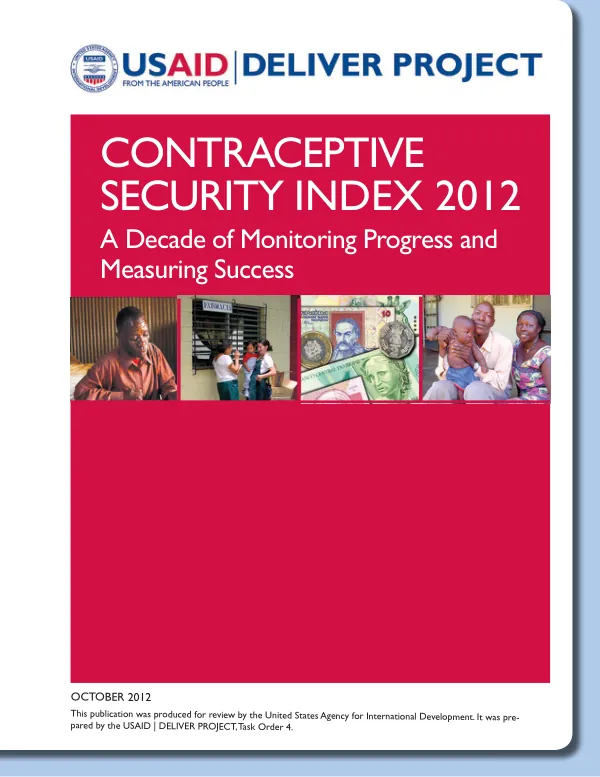
Contraceptive Security Index 2012: A Decade of Monitoring Progress and Measuring Success
Sign inFHI360
Contraceptive Security Index 2012: A Decade of Monitoring Progress and Measuring Success
The Contraceptive Security Index 2012 measures countries' level of contraceptive security through a set of 17 indicators covering five strategic areas for over 60 countries.
2012 · 22 pages
Sign in to readA free account is required to download.
Abstract
The index is a composite measure of a country's ability to ensure that people can choose, obtain, and use quality contraceptives. The 2012 index represents a decade of monitoring progress and measuring success, with new data collected in 2012. The index is constructed from five components: supply chain, finance, health and social environment, access, and utilization. The supply chain component includes indicators such as storage and distribution, logistics management, and forecasting and procurement planning. The finance component includes indicators such as budget allocation, donor funding, and private sector investment. The health and social environment component includes indicators such as provider training, service delivery systems, and social norms and attitudes towards family planning. The access component includes indicators such as availability of contraceptive methods, provider density, and client satisfaction. The utilization component includes indicators such as contraceptive prevalence, unmet need, and unintended pregnancy rates. A total of 67 countries are represented in the 2012 index, with 48 countries having scores for all four indices to date. The raw data for the 17 indicators are presented in Table 1, grouped into the five components used to construct the CS Index. The weighted scores by component and total are presented in Table 2, and the total weighted scores for the 67 countries included in the index are presented in Figure 1. The results show global progress toward contraceptive security, with the highest component scores in supply chain management and the lowest in finance. However, the most progress was made in the finance component over the past decade, with average finance scores across the 48 countries increasing 11 percent since 2003. Component scores for an individual country can be compared within a year, enabling users to identify components that need attention and further assessment. The 48 countries scored in both the 2003 and 2012 indices were divided into three clusters of countries: top, middle, and bottom scorers. Each cluster has an equal number of countries based on countries' ranking in each year by total index scores. The results show that the lowest-scoring countries had the most potential, with their scores improving more than the other two clusters. The Contraceptive Security Index can be used to advocate for contraceptive security, set priorities, improve resource allocation, and monitor progress toward achieving a secure supply of quality contraceptives. The index highlights the need for a multi-sectorial approach to ensure an enabling policy environment, appropriate forecasting and procurement of commodities, efficient supply chains, well-trained providers, effective service delivery systems, an accepting social environment, and adequate financing. The index also shows that movement in rank up or down by a few places at the country level may not represent significant differences or changes in the level of contraceptive security. Therefore, it is essential to review the indicators within the broader context of a country, including aspects not captured in the CS Index due to data limitations. The results of the Contraceptive Security Index 2012 demonstrate that significant progress has been made toward achieving contraceptive security over the past decade. However, challenges remain, and continued efforts are needed to ensure that people can choose, obtain, and use quality contraceptives.