FHI 360
TB CARE Annual Work Plan and Budget
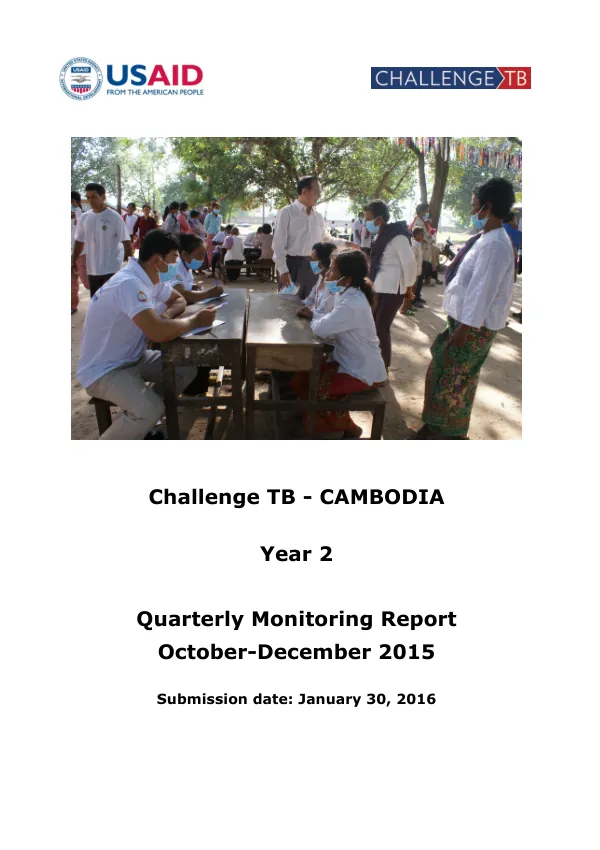
Cambodia's Challenge TB program, led by FHI 360, is a collaborative effort with the World Health Organization (WHO) and the Cambodia National TB Program (NTP).
2016 · 36 pages
Sign in to readA free account is required to download.
Abstract
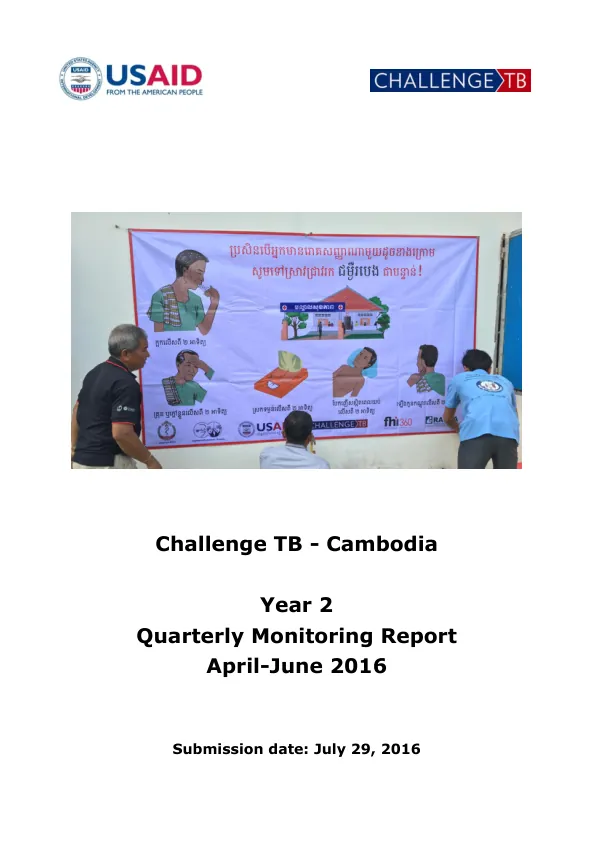
The program's primary objective is to improve TB diagnosis and treatment outcomes in Cambodia. The program operates under the guidance of the USAID-funded cooperative agreement AID-OAA-A-14-00029. During the second quarter of 2016, the program achieved significant milestones in active case finding (ACF) and educational tool development. ACF activities, implemented in 56 health centers across three operational districts, resulted in the screening of 14,499 presumptive TB patients. Among these, 9,067 (62%) were screened, and 230 (1.6%) were bacteriologically confirmed TB cases. Additionally, 2 (0.01%) and 408 (2.8%) patients were diagnosed with rifampicin-resistant and clinically confirmed TB, respectively. The program also developed two patient-education banners, which were finalized and approved by the NTP. These banners aimed to instruct presumptive TB patients on how to produce good-quality sputum and increase knowledge and awareness of TB symptoms. Over 500 banners were displayed in communities, health centers, referral hospitals, and public places to promote TB awareness and health-seeking behavior. A semi-active case finding (SACF) program was assessed in pagodas, with Dr. Alice Zwerling, a senior epidemiologist from KNCV, conducting the evaluation. The assessment revealed that the SACF program provided a higher yield of TB case notifications among the elderly compared to the national TB incidence in 2015. The program also identified challenges, including difficulty in producing sputum on the spot and limited access to chest X-ray services. Technical and administrative challenges were identified, including low rifampicin-resistant TB case notifications due to a suboptimal reimbursement system for sputum transport. To address this, the program will work with sites to pilot a financial support system and evaluate the reimbursement system with CENAT. The program's Year 2 activity progress report highlights the status of planned key activities under two sub-objectives: enabling environment and comprehensive, high-quality diagnostics. The report notes that the Public Private Mix (PPM) TB DOTS activity was not accomplished due to the re-consideration of the PPM approach by the Mission. The NTP director agreed to allow a consultant to review the model of PPM, with the consultant scheduled to arrive in August. The program also developed an operational plan and lab guidelines for national TB labs, which were integrated into existing TB lab guidelines and other relevant documents. However, the task of conducting EQA to all 18% (40/215) microscopic centers was not met due to competing priorities of CENAT staff with Xpert machine expansion and trainings.