MANAGEMENT SCIENCES FOR HEALTH
TB CARE I - Afghanistan End of Project Report
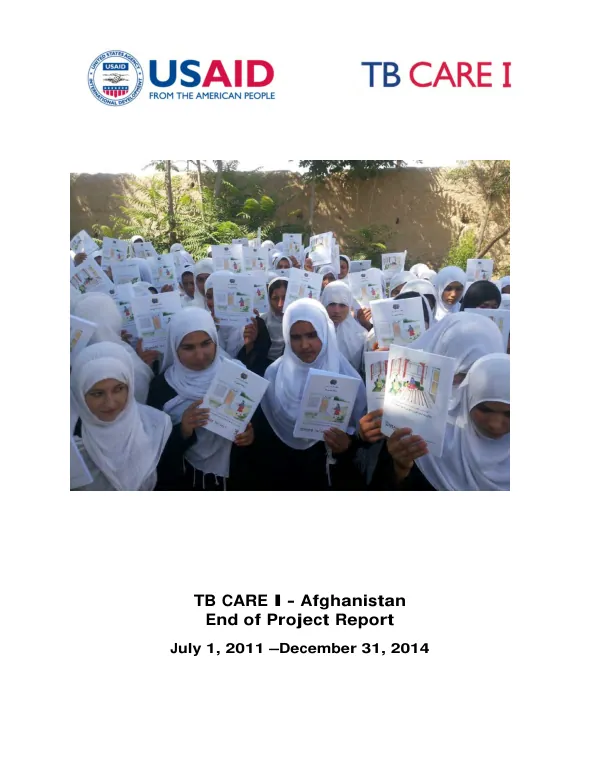
TB CARE I, a USAID-funded project, operated from July 2011 to December 2014 in 13 provinces of Afghanistan.
2014 · 44 pages
Sign in to readA free account is required to download.
Abstract
The project partnered with the National Tuberculosis Program (NTP), the Ministry of Public Health, and local and international organizations to expand access to TB services. TB CARE I assisted the NTP in implementing Urban directly observed therapy short course (DOTS) and Community-Based DOTS (CB-DOTS) to increase TB case detection and treatment. The project also strengthened the health system by revising guidelines on standard operation procedures for case detection and treatment. TB CARE I's efforts led to significant improvements in TB case detection and treatment outcomes. The TB case detection rate for all forms of TB increased from 57% in 2011 to 62% in 2014, exceeding the national case detection rate of 54.4% in 2013. The treatment outcome improved and reached 89% in 2014. In total, 24,814 new sputum smears tested positive and 57,452 of all forms of TB cases were detected in TB CARE I intervention provinces. The project also focused on increasing access to quality TB services through CB-DOTS. Community health workers (CHWs) identified and referred 60,541 presumptive TB cases to TB diagnostic centers, among which 3,714 bacteriologically confirmed TB cases were detected. CHWs also provided directly-observed therapy (DOT) to 3,894 TB patients, resulting in a treatment success rate of 98% compared to the national value of 90%. TB CARE I also supported the NTP's efforts to increase TB case notification through Urban DOTS programs. The project ensured that urban-dwelling residents received access to TB services through the NTP's Urban DOTS programs in partnership with WHO and the private sector. Urban DOTS application in facilities resulted in improved access to DOTS, leading to identification of presumptive TB cases and notification of sputum smear positive and other forms of TB cases. In addition, TB CARE I assisted the NTP in developing its national strategic plan (NSP) for 2014-2018. The project team assisted the NTP in data collection, epidemiological assessment of TB data, and writing the NSP and concept note for the Global Fund to Fight HIV/AIDS, TB, and Malaria (GFATM). The Global Fund approved the concept note in November 2014, and Afghanistan secured $12.4 million for the period 2015-2017. TB CARE I's efforts also resulted in the strengthening of NTP leadership and management capacity. The project team provided four short-term technical assistances (STTAs) to MSH and KNCV, which led to the revision of the NSP to address strategic gaps such as TB in children and strengthening the health system. The project's geographic focus was on 13 provinces of Afghanistan, including Takhar, Badakhshan, Baghlan, Jowzjan, Faryab, Herat, Kandahar, Ghazni, Paktika, Pakiya, Khost, Kabul, and Bamyan. The project's timeframes were from July 2011 to December 2014, with a focus on improving TB case detection and treatment outcomes, increasing access to quality TB services, and strengthening the health system. TB CARE I's implementation details included the development of policy guidelines and training frontline health care staff, supporting supervisory visits, conducting on-the-job training, and providing feedback to BPHS implementers, provincial health teams, and provincial TB coordinators during quarterly review workshops. The project also enhanced active TB case finding at health facilities and conducted TB screenings among household contacts of TB patients. The project's recommendations and lessons learned include the importance of strengthening the health system, increasing access to quality TB services, and improving TB case detection and treatment outcomes. The project's achievements demonstrate the potential of collaborative efforts between government, non-governmental organizations, and international partners to improve TB control in Afghanistan.
Related documents