FAMILY HEALTH INTERNATIONAL
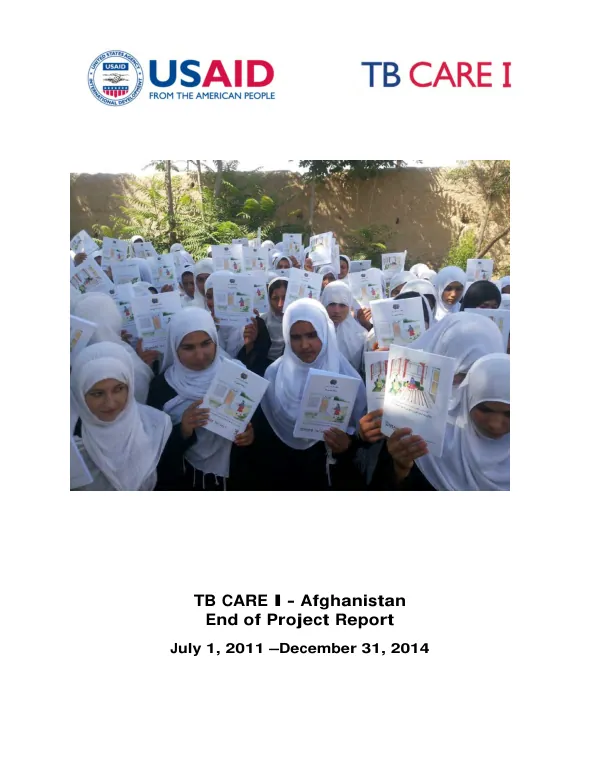
TB CARE I – Afghanistan Quarterly Report April–June 2014
TB CARE I – Afghanistan is a program aimed at helping the country's National Tuberculosis Program (NTP) maximize its outcomes.
2014 · 25 pages
Sign in to readA free account is required to download.
Abstract
The program is led by Management Sciences for Health (MSH) and involves coalition partners World Health Organization (WHO) and KNCV Tuberculosis Foundation (KNCV). Other partners include nongovernmental organizations (NGOs) and Bangladesh Rural Advancement Committee (BRAC). The program's timeframe is October 2013–December 2014, with quarterly reports submitted to USAID. TB case notification is a key focus area for TB CARE I. During the third quarter of the Annual Plan of Activities (APA) 4, the NTP identified 30,821 presumptive tuberculosis (TB) cases that were tested for pulmonary TB, notified 1,742 sputum smear-positive cases, and notified 3,973 TB cases of all forms in the 13 project-supported provinces. The NTP also conducted TB screening among 6,138 contacts of TB patients, notifying 58 as sputum smear-positive TB and 75 all-form TB. Additionally, the screening of children under five years of age at TB CARE I intervention areas enhanced, with a cumulative total of 2,708 under-five children put on INH preventive therapy, exceeding the annual target of 2,000 by 35%. TB CARE I's DOTS implementation in densely populated areas of Kabul City has produced significant results. A project-led assessment of urban DOTS implementation revealed that participating health facilities had identified five times as many TB suspects from June 2013 to June 2014 as they had from January to December 2009. The number of TB cases notified (all forms) had increased by 84 percent, the number of newly identified sputum smear TB-positive cases had increased by 48 percent, and the conversion rate had improved by 29 percent. By 2012, the TB patient treatment success rate had improved by 32 percent to reach 76 percent. TB CARE I continued to assist the NTP in improving access to TB services in the project's 13 intervention provinces. In 2013, the cumulative number of presumptive TB cases identified and screened for TB in the 13 provinces reached 108,623, and from January through June 2014, the provinces identified and tested 58,000 additional presumptive TB cases. The project team also assisted the NTP in conducting quarterly review workshops in the 13 provinces, sensitizing healthcare staff on the importance of presumptive TB case identification, reviewing their performance from the previous quarter, and setting new targets for the coming quarter. The performance review revealed that facilities had made significant improvements in early TB case notification, with 30,000 presumptive TB cases identified and nearly 1,900 (6%) cases of active pulmonary TB of sputum smear-positive TB notified. TB CARE I supported the NTP's efforts to increase TB case notification through community-based (CB) DOTS and urban DOTS programs. The engagement of private and public non-MOPH health facilities resulted in improved access to TB services, with 9,122 presumptive TB cases identified/examined and 2,220 TB cases of all forms notified during the first two quarters of 2014. The urban DOTS contribution to TB case notification was 11% in 2013, with 3,553 cases notified in Kabul. CB-DOTS resulted in the identification of 6,025 presumptive TB cases, making 18% of all presumptive TB cases identified in 13 USAID-supported provinces, and the notification of 579 sputum smear-positive TB cases, making 16% of all smear-positive TB cases diagnosed in 13 provinces. Additionally, 610 diagnosed TB patients received their treatment from community health workers (CHWs) under CB-DOTS at their villages in 13 provinces. TB CARE I is a member of the Concept Note (CN) Development Committee for the Global Fund to Fight AIDS, Tuberculosis and Malaria (GFATM)'s new funding mechanism. The committee, which includes representatives from NTP, Japanese International Cooperation Agency (JICA), BRAC, and WHO, has developed two drafts of the CN and submitted them to the GFATM. The GFATM has commented on these drafts, and the committee has revised them accordingly. The final comments from GFATM are that the CN is in a good shape and acceptable form. TB CARE I helped the NTP conduct two trainings on standard operating procedures (SOPs) for TB diagnosis and treatment during the reporting period. The trainings aimed to enhance the capacity of frontline healthcare staff to provide quality TB services.
Related documents