USAID DEC
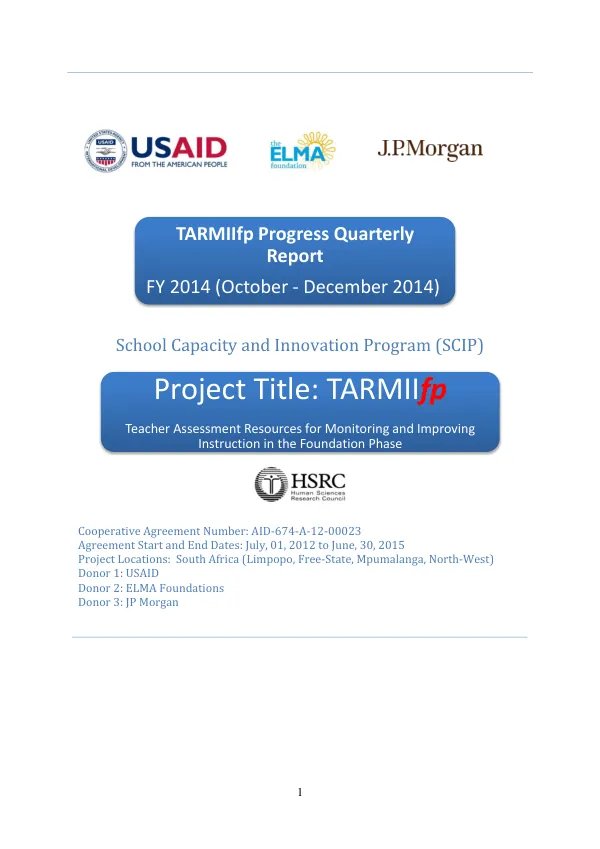
Teacher Assessment Resources for Monitoring and Improving Instruction in the Foundation Phase TARMII_fp
Sign inUSAID
Teacher Assessment Resources for Monitoring and Improving Instruction in the Foundation Phase TARMII_fp
The TARMIIfp project, initiated in 2012, aimed to develop and implement a teacher assessment resource for monitoring and improving instruction in the foundation phase in South Africa.
2012 · 14 pages
Sign in to readA free account is required to download.
Abstract
The project was a collaborative effort between the Human Science Research Council (HSRC), the Department of Basic Education (DBE), and various stakeholders. The project's primary objective was to enhance the quality of education in the foundation phase by providing teachers with a reliable assessment tool. The project's scope encompassed four provinces in South Africa: Limpopo, Free State, Mpumalanga, and North-West. The project's duration was from July 2012 to June 2015, with a budget provided by USAID, ELMA Foundations, and JP Morgan. The project's geographic focus was on the foundation phase, which includes grades 1, 2, and 3. The project's methodology involved the development and implementation of a teacher assessment resource, known as TARMIIfp software. The software was designed to provide teachers with a reliable assessment tool to monitor learner performance and improve instruction. The project's implementation involved various activities, including teacher training, school visits, and data collection. One of the key activities conducted during the quarter October to December 2014 was the administration of learner post-test. The post-test was administered to a sample of grades 1, 2, and 3 learners from both control and experimental schools. The data collected from the post-test was captured and cleaned, and initial analysis indicated improvement in learners' literacy development. The project also conducted a recap training of teachers on the second version of the TARMIIfp software in Mpumalanga. The training was facilitated by two HSRC researchers and attended by 51 teachers. The training focused on the use of the software and its various functions. School visits and monitoring took place in the Free State, where eight schools were visited by two HSRC researchers. The researchers provided project teachers with individual training on the generation of activities from the software, how to print assessment activities, and record learner results. The project also recruited and trained test administrators from a pool of administrators who took part in the administration of the learner baseline. Each of the four districts was responsible for identifying 20 administrators who met the criteria set by the HSRC. The test administrators were given five-hour training sessions on the background of the TARMIIfp study, administration of both the oral and written tests, and scoring of completed tests. The implementation of learner post-test took place over five days during October and November, in a total of 160 schools across the four provinces. Each school had a total of 60 learners tested, who had participated in baseline testing. The testing instruments were collected and handed over to the HSRC research team by the end of the testing week. The project's results and successes included the improvement in learners' literacy development, as indicated by the initial analysis of the post-test data. The project also reported that the TARMIIfp software was a useful and important assessment tool, but teachers would need more time and training to develop confidence in using the tool. The project's future activities included conducting interviews and analysis to develop an understanding and model for the successful implementation of the TARMIIfp software. The project also planned to discuss the impact of TARMIIfp and strategies for large-scale implementation of the software at the next Steering Committee meeting scheduled for early 2015.
Related documents