USAID DEC
Teacher Assessment Resources for Monitoring and Improving Instruction in the Foundation Phase TARMII_fp
Sign inUSAID
Teacher Assessment Resources for Monitoring and Improving Instruction in the Foundation Phase TARMII_fp
The Teacher Assessment Resources for Monitoring and Improving Instruction in the Foundation Phase (TARMIIfp) project is a collaborative effort between the Human Science Research Council (HSRC) and the Department of Basic Education (DBE) in South Africa.
2012 · 16 pages
Sign in to readA free account is required to download.
Abstract
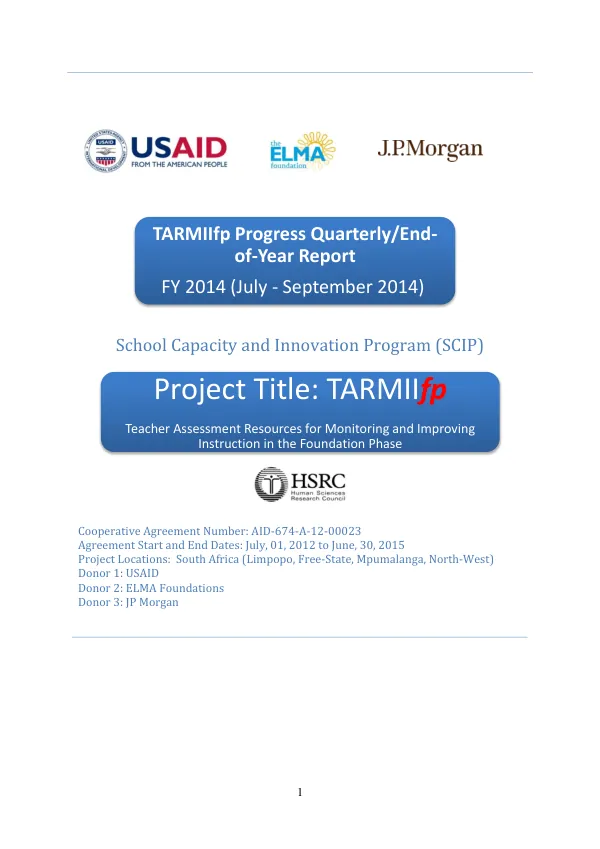
The project aims to enhance literacy development among foundation phase learners by providing teachers with access to and use of teaching and assessment resources. The project began in 2012 and is set to conclude in 2015, with funding from USAID, ELMA Foundations, and JP Morgan. The project focuses on four provinces in South Africa: Limpopo, Free State, Mpumalanga, and North-West. The main activities of the project include the development of a software intended to provide teaching and assessment resources to foundation phase teachers, the installation of the software on teachers' computers, and the provision of support and training to teachers. The project's software is designed to provide teachers with resources to enhance their teaching practices and improve literacy development among their learners. The software includes features such as assessment instruments, baseline learner data collection, and support for teachers. The project also involves the collection of learner baseline data, which is captured by the Data Capturing Unit of the HSRC. During the quarter of July to September 2014, the main activities included the installation of the latest version of the TARMIIfp software, a recap training of teachers on the second version of the software, a Steering Committee meeting in the Free State, and the capturing of learner baseline data for all four provinces. The Steering Committee meeting was held on August 8, 2014, at the Thabo Mofutsanyana district, where it was agreed that recap training would take place from October 14 to 16, 2014, and learner testing from November 3 to 7, 2014. The installation of the latest version of the TARMIIfp software took place in Free State, Mpumalanga, and North-West during August and September 2014. The installation included recording of laptop barcodes and teacher profiles, as well as recording information per school on all software functions performed by teachers. The main issue raised by teachers during the installation was the need for more support, which was addressed through school-based support in the Free State and Limpopo, and a recap training in Mpumalanga. The project also noted that some teachers who were not selected to participate in TARMIIfp were drawn to the project and had created profiles and class lists for grade 4. In the North-West, the district e-Learning Coordinator advised that all laptops be collected and brought to a central point for software installation, which was done at the HSRC offices. The project's findings indicate that teachers were not using the software because they had not mastered how to use it to generate activities and draw reports. To address this issue, recap training sessions and school-based support were planned and implemented in North-West, Free State, and Limpopo during August and September 2014. Training for teachers in Limpopo is scheduled for October 2014. The project also identified that school principals do not give TARMIIfp teachers access to laptops and 3G data cards. To address this issue, the HSRC drafted a letter addressed to school principals to give TARMIIfp teachers access to laptops, which was sent to the respective District Offices for circulation to schools. Overall, the TARMIIfp project aims to enhance literacy development among foundation phase learners by providing teachers with access to and use of teaching and assessment resources. The project's activities and findings indicate that there are challenges to be addressed, including the need for more support and access to laptops and 3G data cards.