USAID DEC
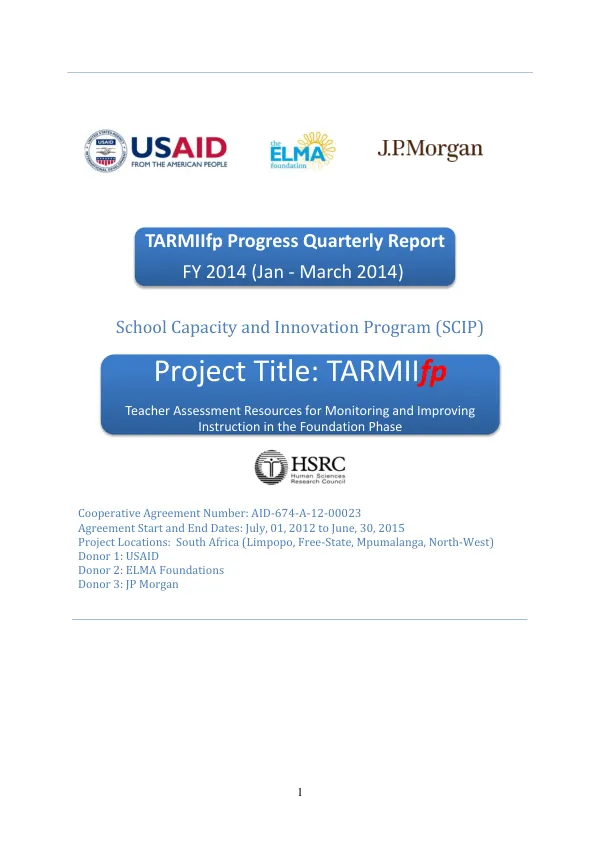
Teacher Assessment Resources for Monitoring and Improving Instruction in the Foundation Phase TARMII_fp
Sign inUSAID
Teacher Assessment Resources for Monitoring and Improving Instruction in the Foundation Phase TARMII_fp
The School Capacity and Innovation Program (SCIP) is a cooperative agreement between USAID, ELMA Foundations, and JP Morgan to support educational development in South Africa.
2012 · 16 pages
Sign in to readA free account is required to download.
Abstract
The program focuses on improving literacy development in the Foundation Phase, which includes grades 1-3. The TARMIIfp project, a key component of SCIP, aims to enhance teacher assessment and monitoring practices to improve literacy outcomes. The TARMIIfp project began in 2012 and is scheduled to conclude in 2015. The project's geographic focus is on four provinces in South Africa: Limpopo, Free State, Mpumalanga, and North-West. The project's primary objective is to test the hypothesis that frequent use of the TARMIIfp software by teachers would have a positive impact on learners' home language literacy development. The project's methodology involves training teachers on formative assessment practices, basic computer competence, and the use of the TARMIIfp software. The software is designed to support teachers in monitoring and improving instruction in the Foundation Phase. The project also involves the administration of a baseline test to collect data on learners' current literacy development. The baseline test consists of two parts: oral language (OL) and written language (WL) components. The OL component tests learners' basic oral proficiency, while the WL component tests their written language proficiency. The test is administered to a sample of 20 learners in grades 1, 2, and 3 in both experimental and control schools. The project's activities for the quarter (January to March 2014) included designing the test instruments, administering the test, marking and data capturing, and data analysis. The project also involved updates of the software and versioning of assessment activities. The major challenges faced during this quarter included industrial strike action of courier services, heavy rainfalls, and the district office's busy planned school activities. The project's future activities include the installation of the second version of the TARMIIfp software, which will include a webhosting facility to enable remote data collection on teachers' use of the software. Workshops will be provided to support teachers in using the software. The project also aims to present the TARMIIfp project to the office of the Director General of the South African Basic Education to pave the way for sustainability and scaling up the project. The project's geographic focus is on four provinces in South Africa: Limpopo, Free State, Mpumalanga, and North-West. The project's timeframes are from 2012 to 2015, with the current quarter (January to March 2014) being a critical period for data collection and testing the hypothesis that frequent use of the TARMIIfp software by teachers would have a positive impact on learners' home language literacy development.