USAID. MISSION TO SWAZILAND
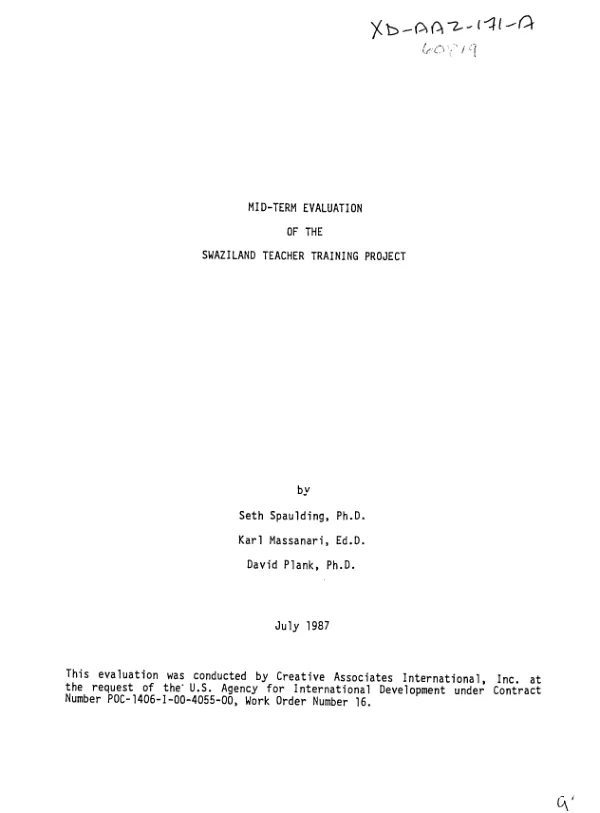
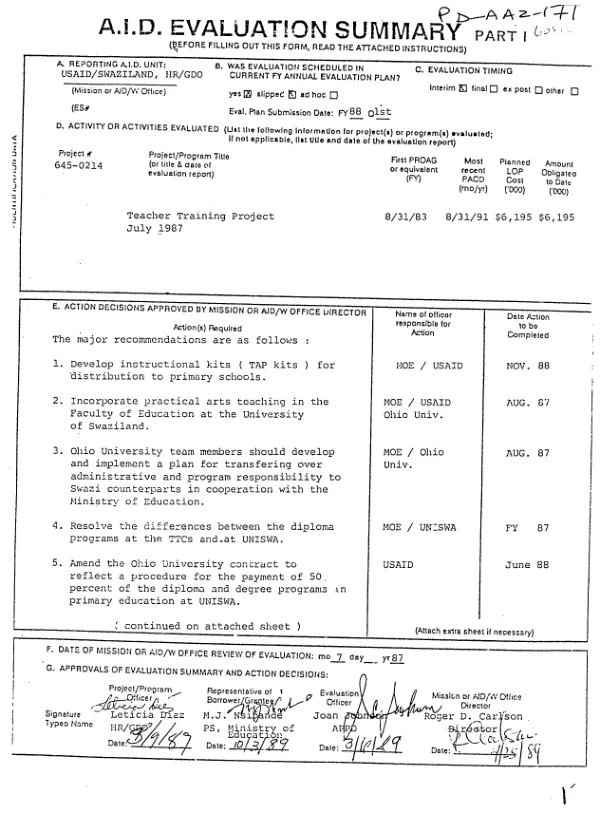
Teacher training project, July 1987
Summarizes interim evaluation (XD-AAZ-171-A) of a project to improve Swaziland"s capacity to train primary school teachers.
1989
Sign in to readA free account is required to download.
Abstract
The project is implemented principally through activities at three teacher training colleges (TTC"s), the University of Swaziland (UNISWA), the National Curriculum Center (NCC), and the Teacher Innovation and Distribution Centers (TIDC"s). The project is a complex venture which has progressed well toward its major goals. (1) It has expanded pre-service programs at all three TTC"s from a 2-year Primary Teaching Certificate (PTC) program to a 3-year Primary Teaching Diploma Program and in doing so has achieved uniformity in primary teacher training. Also, new topics - such as special education, ecology, guidance, environmental education, and curriculum development - have been added to existing pre-service courses. (2) A plan to upgrade the educational qualifications of TTC lecturers is being implemented. By 1991, it is expected that all TTC lecturers will have at least a bachelor"s degree and all principals at least a master"s degrees; those lacking such degrees will be reassigned to teaching positions in primary or secondary schools. (3) The project has helped establish two training programs at UNISWA - a part-time diploma program (this program is to be transferred to the TTC"s) and a B. Ed. program in primary education. (4) In-service teacher education workshops at the TIDC"s have been a major contribution and have quantitatively far exceeded projected numbers; more than 3,000 teachers will benefit by the end of the project. On the negative side, it is unlikely that the TTC"s will produce the goal of 300 new teachers per year, since the Ministry of Education (MOE) has reduced their enrollment by about half. At UNISWA, the B.Ed.for primary education will most likely have difficulty acquiring and retaining a qualified teaching staff. Although a strong commitment is evident among current administrators and lecturers, many problems exist due to personnel changes, dependence on other faculties, the specialization of traditional academic progress at UNISWA, and unrealistic standards for admitting TCC lecturers to degree programs. It is recommended that priority be given to introducing practical arts such as agricultural skills, handicrafts, and vocational/technical education at the NCC, TTC"s, and the UNISWA B.Ed. program. Future projects should also provide instructional materials in primary classrooms, improve supervision and leadership skills among headmasters and inspectors, and strengthen guidance and counseling services. Direct intervention to improve the educational delivery systems should be emphasized, rather than the further upgrading of teacher credentials. The in-service program should be institutionalized within either the MOE, the NCC, or UNISWA in order to ensure its sustainability.
Related documents