USAID DEC
Technical Assistance for Policy Reform II
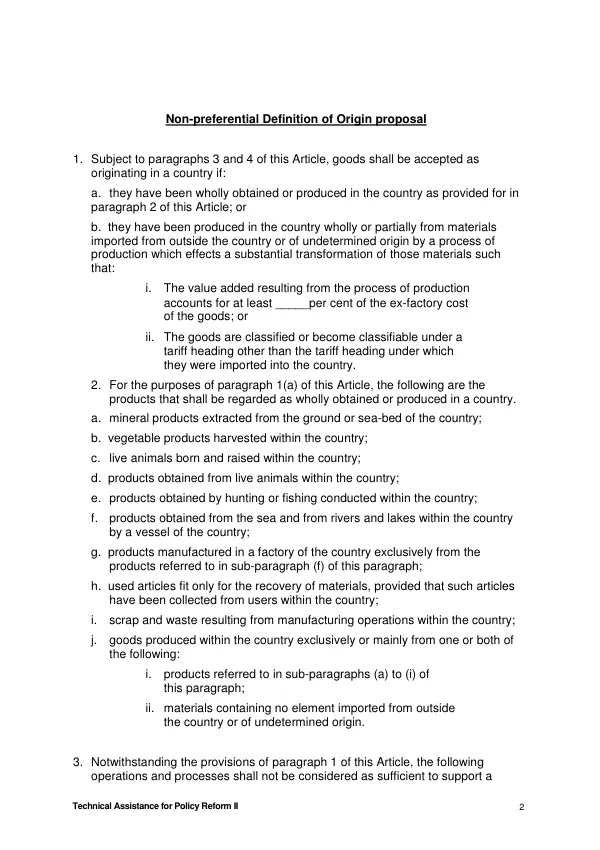
The Non-preferential Definition of Origin proposal outlines the criteria for determining the origin of goods in a country.
2 pages
Sign in to readA free account is required to download.
Abstract
Goods are accepted as originating in a country if they have been wholly obtained or produced in the country, or if they have been produced in the country from materials imported from outside the country or of undetermined origin, with a process of production that effects a substantial transformation of those materials. The substantial transformation of materials is defined as a process where the value added resulting from the production process accounts for at least 40% of the ex-factory cost of the goods, or where the goods are classified or become classifiable under a tariff heading other than the tariff heading under which they were imported into the country. The proposal also lists specific products that are considered to be wholly obtained or produced in a country, including mineral products, vegetable products, live animals, and products obtained from live animals. However, certain operations and processes are not considered sufficient to support a declaration that goods originate from a country. These include simple packaging operations, simple mixing of ingredients, simple assembly of components, and operations to ensure the preservation of merchandise in good condition during transportation and storage. Additionally, changes of packing, marking, labelling, or affixing distinguishing signs on products or their packages, and simple operations such as removal of dust, sifting or screening, sorting, classifying, and matching, are also not considered sufficient. The proposal also states that it shall not override the rule of origin provisions of any trade agreement that has been entered into by Egypt. This means that the rules of origin outlined in the proposal will not supersede any existing trade agreements that Egypt has entered into with other countries.
Related documents