DELOITTE CONSULTING, LLP
Technical Brief: Anti-Corruption in Health
Corruption in the health care system is a pervasive issue in Ukraine, affecting every level of the system.
2021 · 11 pages
Sign in to readA free account is required to download.
Abstract
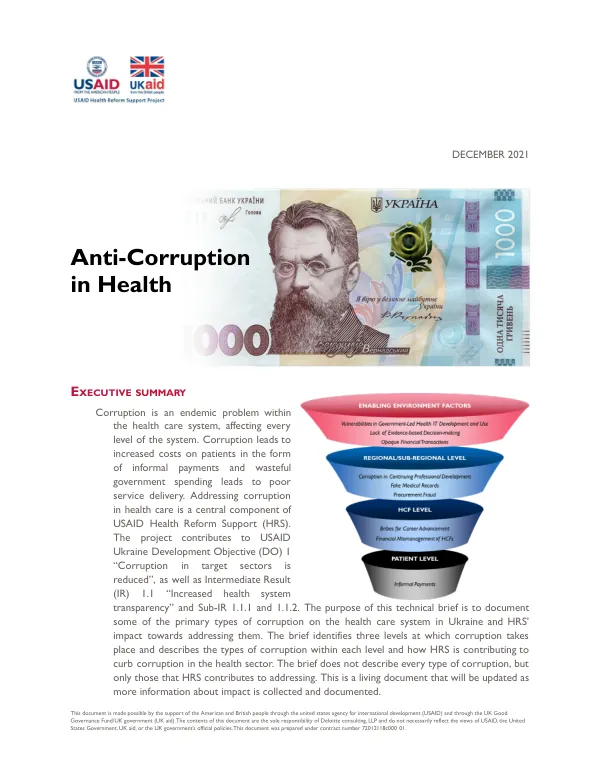
It leads to increased costs for patients in the form of informal payments and wasteful government spending, resulting in poor service delivery. Addressing corruption in health care is a central component of the USAID Health Reform Support (HRS) project, which contributes to the USAID Ukraine Development Objective of reducing corruption in target sectors. The HRS project defines corruption as the abuse of entrusted authority for private gain. Ukraine ranks 117th on Transparency International's 2020 Corruption Perceptions Index, making addressing corruption a priority for the government of Ukraine and international donor organizations. Anecdotal evidence supports the ubiquity of corruption within the health care sector, although it is difficult to define, measure, and discuss due to its illicit nature. The HRS project employs a three-step approach to understanding its impact on addressing corruption: defining corruption types, linking activities to each type, and developing indicators to measure activities. The project creates corruption types using available evidence, expert opinions, and internal discussions among project team members. These types vary from broad to narrow, depending on available knowledge, and include enabling environment factors that contribute to the proliferation of corruption. One type of corruption identified by the HRS project is informal payments, which involve solicitations for bribes made by health care workers to patients in exchange for services that should be free to the patient. Informal payments are a type of petty bribery that directly impact patients, leading to distrust in the health system and deterring patients from seeking care in a timely manner. The project's informal payment studies and social sensing analysis confirmed project assumptions and provided evidence that informal payments are occurring. The HRS project has contributed to reducing informal payments by focusing on the patient side of the bribery relationship. The project's theory of change is that if free services are transparent and better communicated to patients, then patients will have the knowledge to defend themselves when solicited for informal payments. The project has supported the implementation of primary health care and specialized health care reform, which has increased the transparency of covered benefits. The project has also leveraged patients' rights organizations and supported awareness campaigns to communicate benefits to patients and engaged in media campaigns to improve patient awareness of their rights. The HRS project has also addressed the health worker side of the bribery relationship with norm-building activities in Objective 3 and 5. The project produced a Code of Ethics of Medical Workers as part of its transparent HR procedures activities, which was piloted in seven health care facilities and distributed publicly. The project's "Sharing Best Practices" online course emphasizes the importance of shifting to a patient-centered delivery system without informal payments. The HRS project's informal payments surveys are the primary approach used to measure informal payments. A baseline study of primary health care facilities was conducted under the USAID Health System Strengthening for a Sustainable HIV/AIDS Response in Ukraine (HIVRiA) project, and a baseline study of four priority service areas in specialized health care facilities was conducted in 2020. The results of the study will determine if health reforms influenced the behavior of Ukrainians regarding informal payments. The surveys will also allow the National Health Service of Ukraine to more correctly calculate tariffs for corresponding Program of Medical Guarantees packages. According to the 2018 informal payment study, 48% of patients reported making at least one informal payment for receiving primary health care services in the past 12 months. Similarly, the 2020 specialized health care informal payments study found that 53% of patients were asked to make an informal payment during the last five visits. This indicates that informal payments are an endemic problem that the HRS project hopes to address. The project will finalize the follow-up primary health care informal payment study and will conduct a follow-up specialized health care study in the next project year to measure changes.
Related documents