USAID
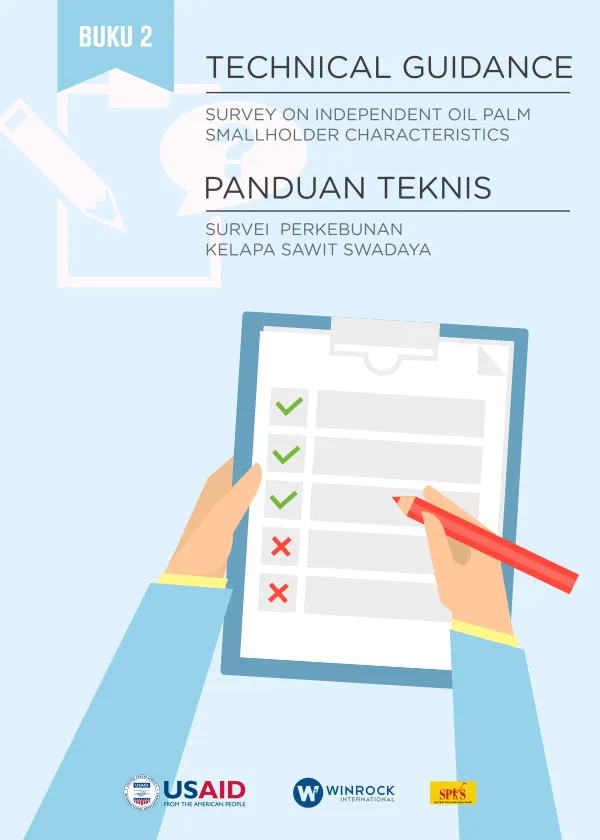
Technical Guidance: Survey on Independent Oil Palm Smallholder Characteristics
Oil Palm Smallholder Characteristics Survey The Government of Indonesia is committed to pursuing sustainable development through improvements in economic, social, and environmental conditions.
2018 · 102 pages
Sign in to readA free account is required to download.
Abstract
In the field of agricultural commodities production, the implementation of sustainable palm oil practices began in 2011 following the launch of the Indonesian Sustainable Palm Oil (ISPO) certification system. The certification aimed to regulate palm oil practices based on principles and criteria for sustainable palm oil production to improve Indonesia's competitiveness in the global market. However, qualifying for the ISPO certification is challenging for independent palm oil smallholders. Meeting the prerequisites for certification is costly and requires resources and clarity on the legality of the land that smallholders own. Around 40% of Indonesian palm oil is produced by independent smallholders, but little effort has been made to help these smallholders meet the certification prerequisites. As a result, smallholders encounter obstacles in transforming their operations into sustainable businesses and improving their position in the market. The Oil Palm Smallholders Association (SPKS) is an organization that represents the interests of smallholders and aims to improve the governance of oil palm plantations through empowering smallholders and improving policies. SPKS has a vested interest in contributing to the effort of achieving sustainable oil palm production and has partnered with Winrock International through the ASLI Project to support independent palm oil smallholders. One of the activities of this project is to survey oil palm smallholder characteristics, including plantation mapping, to obtain a preliminary understanding of independent smallholder characteristics. The survey aims to provide comprehensive guidelines and a framework for conducting surveys on independent smallholder characteristics. The main objectives of the survey are to provide direct and objective guidance to those conducting surveys on smallholders and to establish a clear survey framework to ensure a high level of accuracy and consistency in data collection and results. The survey is part of SPKS' efforts to achieve sustainable palm oil production in accordance with the Indonesian government's sustainable development goals. The survey aims to obtain information on oil palm smallholders and their practices, including social, economic, and environmental data, land tenure, and cultivation practices. The results of the survey will be used to assess the characteristics and readiness of smallholders to implement sustainable palm oil practices and obtain certification in accordance with the ISPO principles and criteria. To conduct the survey, a workflow must be established to identify the steps to conduct the survey and analyze the results. The workflow can be adjusted to meet the needs of the survey as it is being executed. The survey methods used in the field survey include interviews, observations, and observations of the smallholder's plantation to evaluate its physical condition, including agronomic condition, topography, environment, and cultivation practice. The interview is a conversation with a specific purpose, undertaken by the interviewer and the interviewee. The interview questions are compiled in advance and targeted at a preselected group of respondents. The interview aims to obtain data on the smallholder's household, economic, and legal status, as well as information on plantation practices undertaken by the smallholders. The observation technique is used to collect data through direct observations and a careful and systematic recording of the observations. The interviewer will perform two types of observations: direct observation of the daily activities of the smallholders and their families, and field observation of the smallholder's plantation to evaluate its physical condition. The questionnaire consists of a series of written questions on a problem or field to be studied. The list of questions used in the study are compiled in advance and targeted at a preselected group of respondents. The survey aims to obtain information on the existence and patterns of plantations owned by independent smallholders, as well as their readiness to implement sustainable palm oil practices and obtain certification in accordance with the ISPO principles and criteria.