USAID DEC
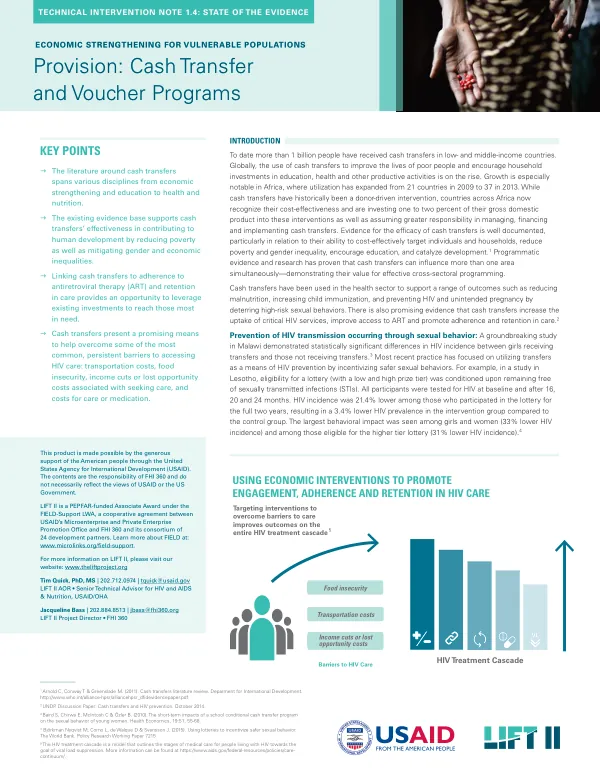
Technical Intervention Note 1.4: State of the Evidence on Cash Transfers and HIV Care
Sign inFHI 360
Technical Intervention Note 1.4: State of the Evidence on Cash Transfers and HIV Care
The literature around cash transfers spans various disciplines, including economic strengthening, education, health, and nutrition.
2015 · 2 pages
Sign in to readA free account is required to download.
Abstract
The existing evidence base supports cash transfers' effectiveness in contributing to human development by reducing poverty and mitigating gender and economic inequalities. Cash transfers have been used in the health sector to support a range of outcomes, including reducing malnutrition, increasing child immunization, and preventing HIV and unintended pregnancy by deterring high-risk sexual behaviors. Evidence suggests that cash transfers can influence more than one area simultaneously, demonstrating their value for effective cross-sectoral programming. In the context of HIV prevention, cash transfers have been used to incentivize safer sexual behaviors. For example, a study in Lesotho found that eligibility for a lottery was conditioned upon remaining free of sexually transmitted infections, resulting in a 21.4% lower HIV incidence among participants. The HIV treatment cascade is a model that outlines the stages of medical care for people living with HIV towards the goal of viral load suppression. Cash transfers have been used to overcome barriers to HIV care, including transportation costs, food insecurity, and income cuts or lost opportunity costs. Targeting interventions to overcome these barriers improves outcomes on the entire HIV treatment cascade. A study in Uganda found that cash transfers of US $5-8 per month to cover transportation costs to an HIV clinic increased treatment adherence among patients. After one year, cases lost to follow up were nearly 50% lower in the intervention group than the control group. In-depth interviews revealed that HIV-affected individuals who received an unconditional cash transfer through the Malawi Social Cash Transfer scheme reported using the money to buy ART medication at the hospital and for transport to receive ART, removing barriers to treatment. The literature points towards recurrent barriers for health service uptake and retention in HIV care, including transportation costs, food shortages, and inability to take time off from work or other responsibilities to keep up with clinical appointments. The evidence base for cash transfers linked to the health sector, particularly HIV prevention, care, and treatment, shows that they can be highly effective for HIV prevention and adherence and retention, under certain conditions.