USAID DEC
Temporal Variation and Association of Aflatoxin B1 Albumin-Adduct Levels with Socio-Economic and Food Consumption Factors in HIV Positive Adults
Sign inWORLD HEALTH ORGANIZATION
Temporal Variation and Association of Aflatoxin B1 Albumin-Adduct Levels with Socio-Economic and Food Consumption Factors in HIV Positive Adults
The association between aflatoxin exposure and immune system alteration in humans suggests that aflatoxin could suppress the immune system and work synergistically with HIV to increase disease severity and progression to AIDS.
2015 · 12 pages
Sign in to readA free account is required to download.
Abstract
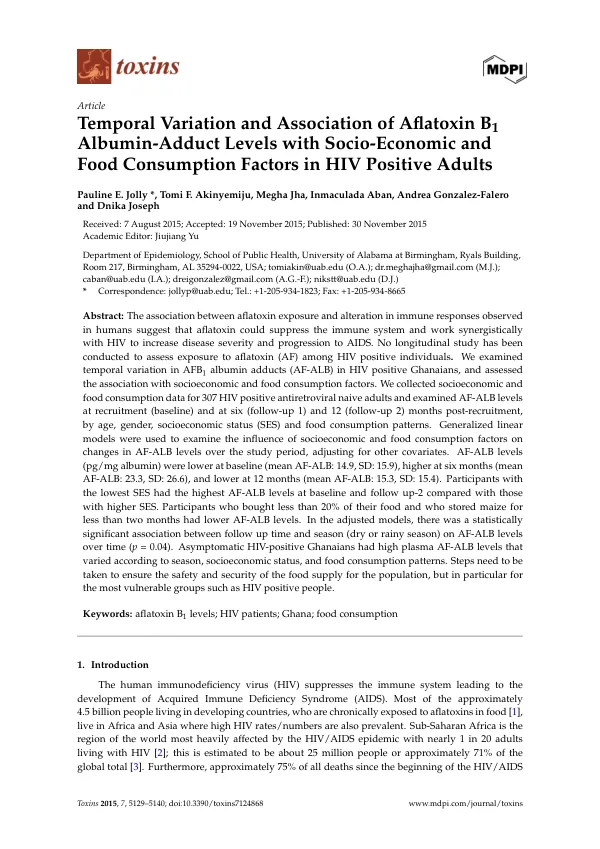
No longitudinal study has been conducted to assess exposure to aflatoxin (AF) among HIV-positive individuals. This study examined temporal variation in AFB1 albumin adducts (AF-ALB) in HIV-positive Ghanaians and assessed the association with socioeconomic and food consumption factors. The study collected socioeconomic and food consumption data for 307 HIV-positive antiretroviral-naive adults and examined AF-ALB levels at baseline and at six and 12 months post-recruitment, by age, sex, socioeconomic status, and food consumption patterns. Generalized linear models were used to examine the influence of socioeconomic and food consumption factors on changes in AF-ALB levels over the study period, adjusting for other covariates. AF-ALB levels were lower at baseline (mean: 14.9, SD: 15.9), higher at six months (mean: 23.3, SD: 26.6), and lower at 12 months (mean: 15.3, SD: 15.4). Participants with the lowest socioeconomic status (SES) had the highest AF-ALB levels at baseline and follow-up 2 compared with those with higher SES. Participants who bought less than 20% of their food and who stored maize for less than five months had lower AF-ALB levels. In the adjusted models, there was a significant association between follow-up time and season (dry or rainy season) on AF-ALB levels over time (p = 0.04). Asymptomatic HIV-positive Ghanaians had high plasma AF-ALB levels that varied according to season, socioeconomic status, and food consumption patterns. The study found that aflatoxin exposure was associated with immune system alteration and increased disease severity in HIV-positive individuals. The majority of study participants were between ages 30-39 years, with male participants slightly older than females (36% of males were ≥40 years compared with 22% of females, p = 0.0001). Most participants were currently married, and females were significantly less likely to belong to high SES groups compared with males (52% vs. 28%, p = 0.001). The majority of participants reported not growing any of their food, and 55% reported buying more than 20% of their food. Almost 70% of participants stored maize for short periods (0-2 months), and the majority of participants reported storing less than 25% of their maize. About 66% of participants reported consuming maize at least two times a week, with a higher percentage of females consuming maize at least two times a week compared with males (69% vs. 53%, p = 0.05). About 45% of participants reported consuming groundnuts at least two times a week. The study found that aflatoxin exposure was associated with immune system alteration and increased disease severity in HIV-positive individuals. The results suggest that aflatoxin exposure varies according to season, socioeconomic status, and food consumption patterns. The study highlights the need to ensure the safety and security of the food supply for the population, particularly for vulnerable groups such as HIV-positive individuals.