INTERNATIONAL FOOD AND POLICY RESEARCH INSTITUTE
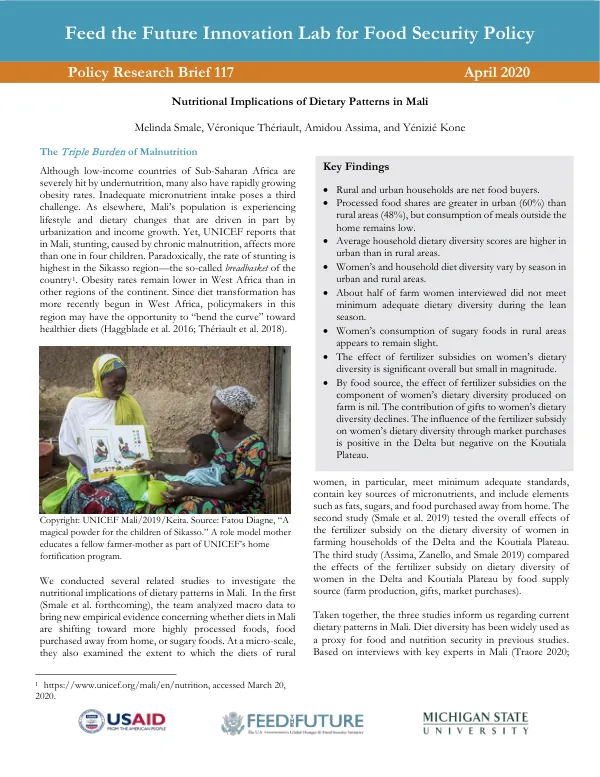
Nutritional Implications of Dietary Patterns in Mali
The agricultural development initiative in Mali began with a focus on understanding the nutritional implications of dietary patterns in the country.
2020 · 4 pages
Sign in to readA free account is required to download.
Abstract
The initiative involved several related studies to investigate the effects of dietary patterns on nutritional outcomes. The studies analyzed macro data to examine whether diets in Mali are shifting toward more highly processed foods, food purchased away from home, or sugary foods. At a micro-scale, the studies examined the extent to which the diets of rural women meet minimum adequate standards, contain key sources of micronutrients, and include elements such as fats, sugars, and food purchased away from home. The studies also tested the overall effects of the fertilizer subsidy on the dietary diversity of women in farming households of the Delta and the Koutiala Plateau. The studies found that rural and urban households in Mali are net food buyers, with purchased foods representing a significant portion of their average food budget. Highly processed food composed a larger share of the urban diet, while sugary foods represented a smaller share of the average budget. Maize was found to be less important than expected, with a smaller share of the budget allocated to it in urban areas. The household diet diversity score (HDDS) measures food access of a household to a number of different food groups, but sheds no light on intrahousehold distribution of dietary diversity, its equity or equality. Individual dietary diversity indicators, such as the women's dietary diversity score (WDDS) and minimum dietary diversity for women (MDD-W), provide information on individual household members. The MDD-W is a binary variable measuring whether or not the respondent's consumption exceeded 5 out of 10 food groups in the recall period. The studies utilized several econometric models to test the effects of fertilizer subsidies on diet quality of women of reproductive age and by source of food supply (on-farm production, purchase, or gifts). Analysis by component provides information about the channel through which the subsidized fertilizer program affects diet quality outcomes. At a macro-scale, the studies analyzed food group intake patterns across areas of residency following an approach similar to that applied by Tschirley et al. (2015). The results of the studies indicate that purchased foods represented 96% of the average food budget of urban households in either season, while in rural areas, purchased food represented 72% of budgets during the hungry season and 60% during the harvest season. Highly processed food composed 15% of the urban diet, while sugary foods represented 4-6% of the average budget. Maize was found to be less important than expected, with a smaller share of the budget allocated to it in urban areas. The studies also found that mean HDDS scores differ statistically at a significance level under 1% between urban and rural areas in the "hungry season," and also in the post-harvest season. They also differ by season in both urban and rural areas, attesting to continued strong linkages between towns and countryside. While these findings may convey information concerning access to food, they provide limited nutritional information since groups include spices and condiments, fats and oils. The studies suggest that policymakers in Mali may have the opportunity to "bend the curve" toward healthier diets, as diet transformation has more recently begun in West Africa. The findings of the studies inform policymakers about current dietary patterns in Mali and provide insights into the effects of fertilizer subsidies on diet quality outcomes.