USAID DEC
Tenure and Global Climate Change (TGCC) Program: Strengthening Resource Tenure Governance and Property Rights
Sign inOXFAM INTERNATIONAL
Tenure and Global Climate Change (TGCC) Program: Strengthening Resource Tenure Governance and Property Rights
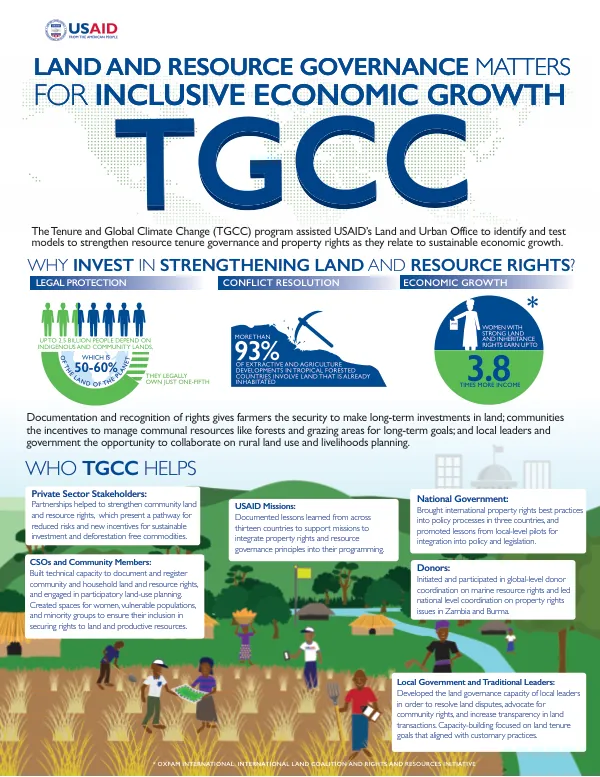
The Tenure and Global Climate Change (TGCC) program was initiated to strengthen resource tenure governance and property rights as they relate to sustainable economic growth.
2018 · 2 pages
Sign in to readA free account is required to download.
Abstract
The program was led by the USAID's Land and Urban Office and aimed to identify and test models to support missions in integrating property rights and resource governance principles into their programming. TGCC worked in 12 countries, including Central America, Paraguay, Ghana, Zambia, Tanzania, Bangladesh, Indonesia, Nepal, Philippines, Vietnam, Burma, and others. The program focused on various aspects of land and resource governance, including documentation and recognition of rights, capacity-building for local leaders, and partnerships with private sector stakeholders. In Burma, the program reached 7,500 participants through 220 events, strengthening their understanding of land governance. In Zambia, 1,000+ participants attended 32 district, provincial, and chief Land Policy dialogues. The program also mapped 300,000+ hectares of community lands for the first time in Burma, Zambia, and Vietnam, and integrated them into open access systems. National Land Use Policy was adopted in Burma and integrated into laws/policies. Land Policy development was supported in Zambia, and a Coastal Forest Policy was implemented in Vietnam. The program also documented resource rights for 550+ communities in Zambia, Burma, and Vietnam, and demarcated land for 15,000+ households. TGCC also explored the rights dimensions of restoration and management success in Indonesia and Tanzania. In Vietnam, 3 communes developed participatory coastal management plans, and land use planning and wildlife ownership rights were integrated into World Bank benefit sharing activities in Zambia. The program also supported community forest management instruments in Zambia and provided job aids for USAID missions on integrating resource rights into fisheries programs. The program's accomplishments included the development of participatory coastal management plans in Vietnam, the integration of tenure into World Bank benefit sharing activities in Zambia, and the support of community forest management instruments in Zambia. Additionally, the program improved coastal resilience across three communes and 800 hectares of coastal mangroves in Vietnam.
Related documents