PRESIDENT'S EMERGENCY PLAN FOR THE U.S. FOR AIDS RELIEF
Thai Red Cross AIDS Research Centre, Thailand Performance Report FY19Q4
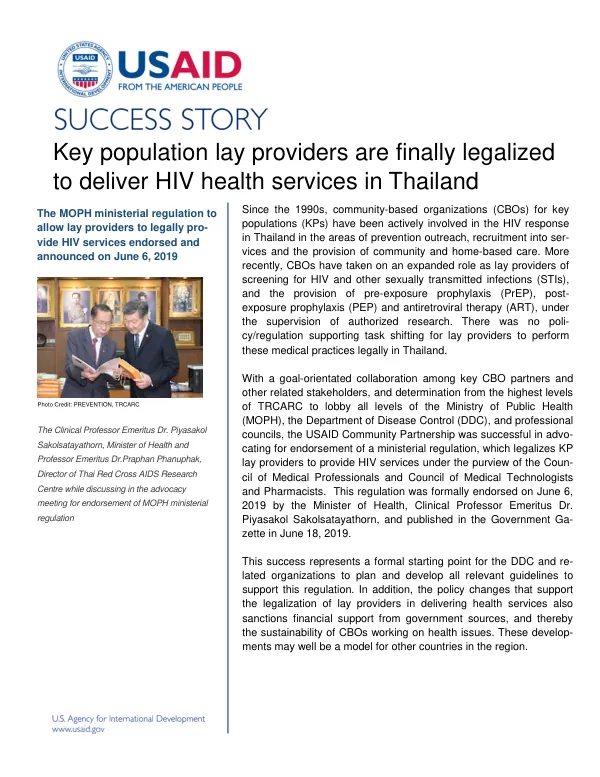
The USAID Community Partnership Project, a collaborative effort between the Thai Red Cross AIDS Research Centre (TRCARC) and three community-based organizations (CBOs), continued to accelerate project implementation under three key strategic objectives (SO) to assure the achievement of the project goal of sustaining the technical assistance (TA) platform for key population-led health services (KPLHS).
2019 · 15 pages
Sign in to readA free account is required to download.
Abstract
The three key SOs under the project are: SO1, to build the capacity of CBOs to provide high-quality KPLHS; SO2, to establish certification systems that allow CBOs to secure sub-national endorsement of KPLHS; and SO3, to mobilize and sustain resources to sustain the KPLHS TA platform. During this report period, the Project focused on following up 192 health workers (CHW) under the LINKAGES project and the Global Fund-supported Stop TB and AIDS through RT (GF-STAR) project, who have already received face-to-face training from the Project, and either need to retake the theoretical exam and/or complete the practicum and prepare for certification. The Project also increased efforts in developing the e-learning system to support all trained CHWs in reviewing the training courses in order to re-test according to the certification process criteria. Two courses, Basic Information on HIV and Related Infections and HIV Counseling, were developed and uploaded to the e-learning system and made available to the CHWs. In addition, 7 CHWs completed the requirements of assessment for certification in this quarter, and their achievements will be submitted to the training and certification committee for review and the issuing of certificates. The Project intensified efforts in advocacy and in the development of a national certification system to support certified CBOs and CHWs for further provision of services according to the ministerial regulation supporting KPLHS. The Project presented the KPLHS training curricula and the certification system developed by the Project to the working group to be used as a model for developing the national certification system and to ensure that this system supports the registry of CHWs trained under the Project. Regarding demand creation for resource mobilization to sustain the platform, the Project promoted and branded the platform through different channels, including meetings and through meetings with potential resources, both at the central and provincial level, such as the National Health Security Office (NHSO) and Provincial Health Offices (PHO). The Project was requested to provide technical assistance to healthcare providers from Surin Province and health care volunteers from the Samed Municipality, Chonburi Province. The healthcare providers from Surin Province received training on gender sensitivity, HIV, and related infections, and the health care volunteers from the Samed Municipality received training on gender sensitivity and HIV. The Project did not conduct any capacity building trainings for CBO staff under LINKAGES during this quarter. However, the development of the course, HIV and STI Testing, has been ongoing, and additional technical content has been gathered on HIV self-testing via finger and oral fluid. The tools and materials to be used in this module are currently being revised. The drafting of a training course adapted from the Alcohol, Smoking, and Substance Involvement Screening Test (ASSIST) that links brief interventions for hazardous and harmful substance use was also initiated in Q4FY19. The TRCARC has continued to develop virtual training packages in Q4FY19. The website content designer and communications officers have assisted in the development of outlines and storyboards suggesting learning activities for modules from the Basic Information on HIV and Related Infections and HIV Counseling courses. The approved storyboards will be converted to Adobe Captivate and should be available at the end of Q1FY20. The virtual online training courses will include sessions with an online quiz with randomized questions and answers at the end of each module. At the completion of each online training course, CHWs must take a final online exam with randomized questions and answers, achieving a final score of 80% or higher. In spite of these developments, CHWs who took the face-to-face training courses but did not pass the training exam at the 80% score threshold were in need of revision and re-testing. Therefore, existing learning materials from the courses, Basic Information on HIV and Related Infections and HIV Counseling, were transformed into e-learning modules to support refresher training and revision for those CHWs. Quizzes were added at the end of each module to help prepare for the final exam. The final exams were expanded and reviewed to support randomized questions and answers online. The Project has advocated for and advocated for and arranged for case collection, coaching, and assessment of CHWs at each site. By the end of Q4FY19, 7 CHWs completed case collection and were assessed for certification. These CHWs were from RSAT Bangkok (4), RSAT Nonthaburi (1), RSAT Pathumthani (1), and SWING (1). Nine additional CHWs from Bangkok, Chiang Rai, and Songkhla have completed case collection and will be assessed for certification before the end of Q1FY20. Some CBO staff