USAID DEC
Key population lay providers are finally legalized to deliver HIV health services in Thailand
Sign inTHAI RED CROSS AIDS RESEARCH CENTRE
Key population lay providers are finally legalized to deliver HIV health services in Thailand
The legalization of key population lay providers to deliver HIV health services in Thailand was endorsed and announced on June 6, 2019, through the Minister of Public Health's ministerial regulation.
2019 · 1 pages
Sign in to readA free account is required to download.
Abstract
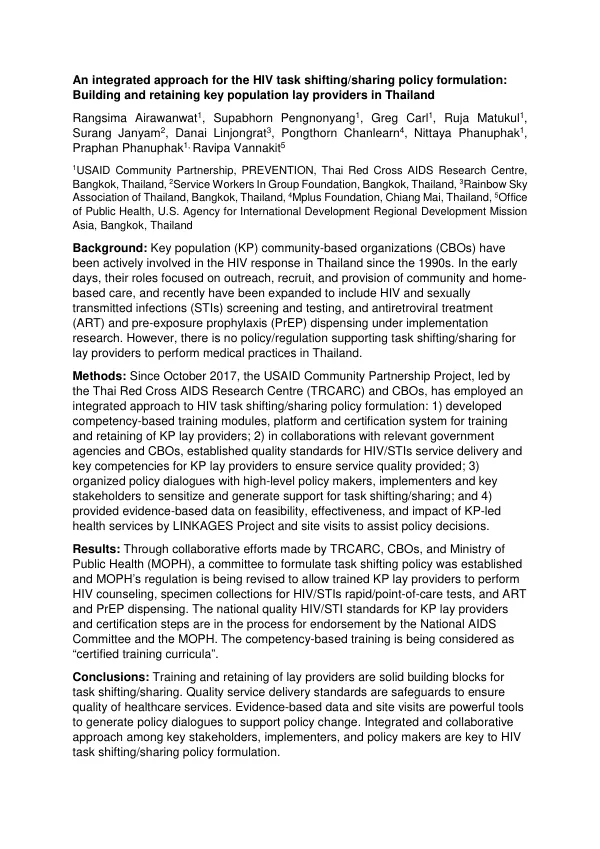
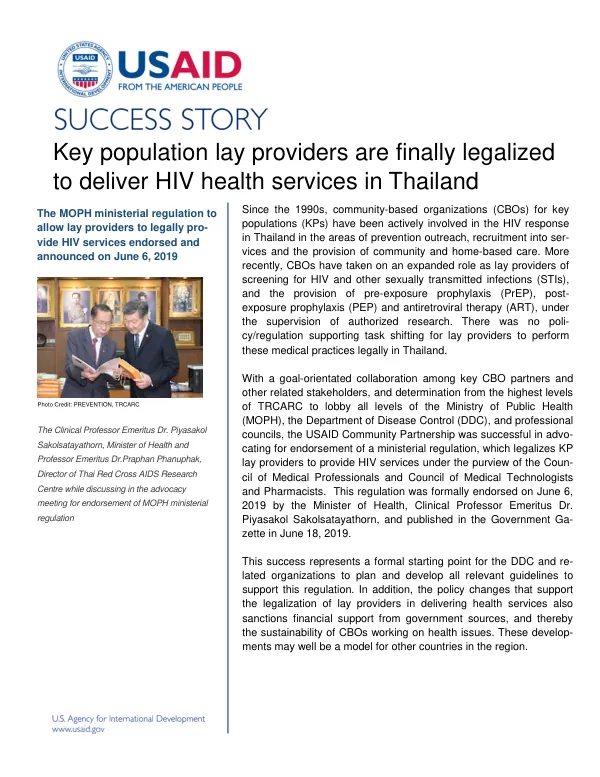
This regulation allows lay providers to legally provide HIV services under the supervision of authorized professionals. Community-based organizations (CBOs) for key populations (KPs) have been actively involved in the HIV response in Thailand since the 1990s. Their roles have expanded over time to include lay provider services such as HIV and sexually transmitted infections (STIs) screening, pre-exposure prophylaxis (PrEP), post-exposure prophylaxis (PEP), and antiretroviral therapy (ART) under authorized research supervision. However, there was no policy or regulation supporting task shifting for lay providers to perform these medical practices legally in Thailand. A collaborative effort among key CBO partners, stakeholders, and the Thai Red Cross AIDS Research Centre (TRCARC) led to the successful advocacy for the endorsement of the ministerial regulation. This regulation was formally endorsed by the Minister of Health, Clinical Professor Emeritus Dr. Piyasakol Sakolsatayathorn, and published in the Government Gazette on June 18, 2019. The regulation allows lay providers to operate under the purview of the Council of Medical Professionals and Council of Medical Technologists and Pharmacists. The success of this regulation represents a starting point for the Department of Disease Control and related organizations to develop guidelines supporting the legalization of lay providers. The policy change also sanctions financial support from government sources, ensuring the sustainability of CBOs working on health issues. This development may serve as a model for other countries in the region. The implementation of this regulation is expected to enhance the delivery of HIV services to key populations in Thailand. The expanded role of CBOs as lay providers will improve access to HIV prevention, treatment, and care services, ultimately contributing to the country's efforts to combat the HIV epidemic.
Related documents