USAID DEC
An integrated approach for the HIV task shifting/sharing policy formulation: Building and retaining key population lay providers in Thailand
Sign inTHAI RED CROSS AIDS RESEARCH CENTRE
An integrated approach for the HIV task shifting/sharing policy formulation: Building and retaining key population lay providers in Thailand
The HIV task shifting/sharing policy formulation in Thailand aims to build and retain key population lay providers.
2020 · 1 pages
Sign in to readA free account is required to download.
Abstract
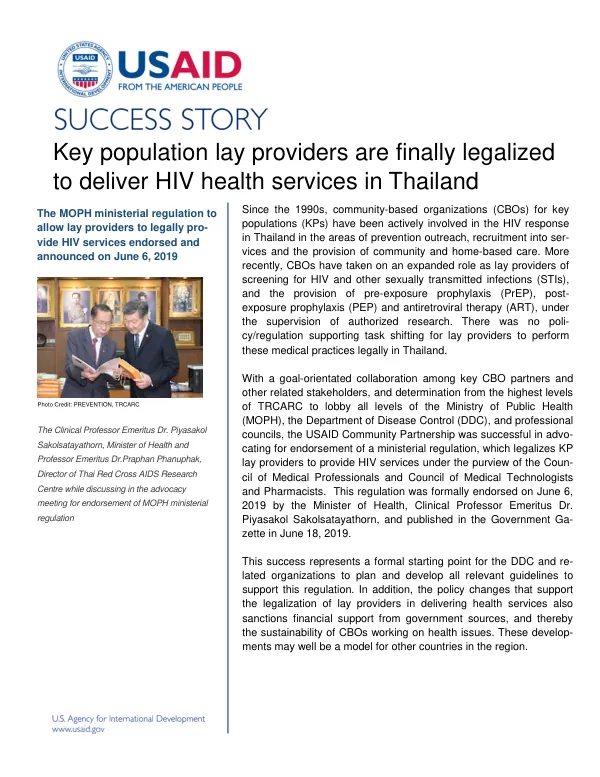
Key population community-based organizations have been involved in the HIV response in Thailand since the 1990s, initially focusing on outreach, recruitment, and community-based care. Their roles have expanded to include HIV and sexually transmitted infections screening and testing, and antiretroviral treatment and pre-exposure prophylaxis dispensing. Since October 2017, the USAID Community Partnership Project, led by the Thai Red Cross AIDS Research Centre and community-based organizations, has employed an integrated approach to HIV task shifting/sharing policy formulation. This approach involves developing competency-based training modules, a platform, and certification system for training and retaining key population lay providers. Quality standards for HIV/STIs service delivery and key competencies for key population lay providers have been established in collaboration with relevant government agencies and community-based organizations. The project has also organized policy dialogues with high-level policymakers, implementers, and key stakeholders to sensitize and generate support for task shifting/sharing. Evidence-based data on the feasibility, effectiveness, and impact of key population-led health services have been provided through the LINKAGES Project and site visits to assist policy decisions. As a result, a committee to formulate task shifting policy has been established, and the Ministry of Public Health's regulation is being revised to allow trained key population lay providers to perform HIV counseling, specimen collection for HIV/STIs rapid/point-of-care tests, and antiretroviral treatment and pre-exposure prophylaxis dispensing. The national quality HIV/STI standards for key population lay providers and certification steps are in the process of being endorsed by the National AIDS Committee and the Ministry of Public Health. The competency-based training is being considered as "certified training curricula." The integrated and collaborative approach among key stakeholders, implementers, and policymakers has been a key factor in HIV task shifting/sharing policy formulation. Training and retaining lay providers are solid building blocks for task shifting/sharing, while quality service delivery standards are safeguards to ensure the quality of healthcare services.