USAID
The African Economic Crisis Revisited
The African economic crisis has been a persistent issue, with significant implications for USG policy and AID's development objectives in Africa.
2010 · 30 pages
Sign in to readA free account is required to download.
Abstract
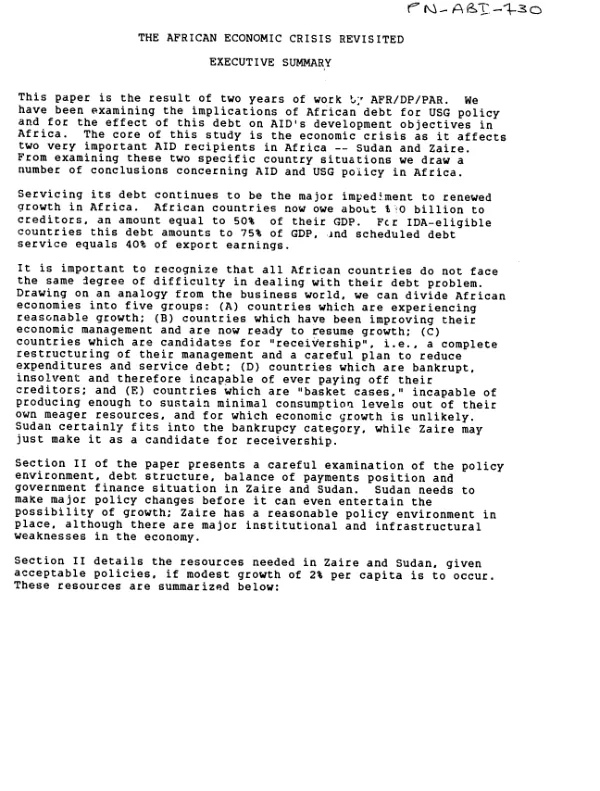
The core of this study focuses on the economic crisis as it affects two important AID recipients in Africa: Sudan and Zaire. Servicing debt continues to be the major impediment to renewed growth in Africa, with African countries owing approximately $100 billion to creditors, an amount equal to 50% of their GDP. For IDA-eligible countries, debt amounts to 75% of GDP, with scheduled debt service equaling 40% of export earnings. African economies can be divided into five groups: countries experiencing reasonable growth, countries improving their economic management and ready to resume growth, countries candidates for "receivership," countries bankrupt and insolvent, and countries "basket cases." Sudan certainly fits into the bankruptcy category, while Zaire may just make it as a candidate for receivership. Section II of the paper presents a careful examination of the policy environment, debt structure, balance of payments position, and government finance situation in Zaire and Sudan. Sudan needs to make major policy changes before it can entertain the possibility of growth, while Zaire has a reasonable policy environment in place, although there are major institutional and infrastructural weaknesses in the economy. The resources needed in Zaire and Sudan, given acceptable policies, for modest growth of 2% per capita are substantial. The average annual resource needs for Sudan are $2.1 billion, with a planned ODA of $700 million and an unfilled gap of $1.4 billion. For Zaire, the average annual resource needs are $1.3 billion, with a planned ODA of $331 million and an unfilled gap of $963 million. Assuming the numbers above are accurate, the policy options available to the donor community and the USG are examined in this paper. Five policy options are considered: Financing, Cash and Carry, Spiraling Down, Triage, and Muddle Through. Financing growth in Sudan or Zaire through debt reschedulings or increased ODA is unlikely, as even with the Baker Plan, there is little prospect for sizeable increases in ODA. Debt rescheduling does not solve the problem, but rather puts off the day of reckoning. The Cash and Carry option involves assuming the major burden of financing and conditioning assistance on structural adjustment. This option requires the USG to accept that debt service, particularly to multilateral agencies, is a secondary objective to economic restructuring and resumption of economic growth. Riding the Downward Spiral involves acknowledging government impotence and limiting government interventions in the private economy. This approach is minimalist and cannot be expected to have lasting economic impact. Triage involves carefully prioritizing objectives in Africa, calculating the cost in terms of financial and political resources, and using those resources to achieve objectives that can be achieved. This approach recognizes that development has not occurred in Africa and that both donors and African governments are responsible for this failure. The USG is incapable of achieving its myriad objectives everywhere in Africa, and the more it seeks to achieve many objectives, the more likely it is to fall short of all of them.