USAID DEC
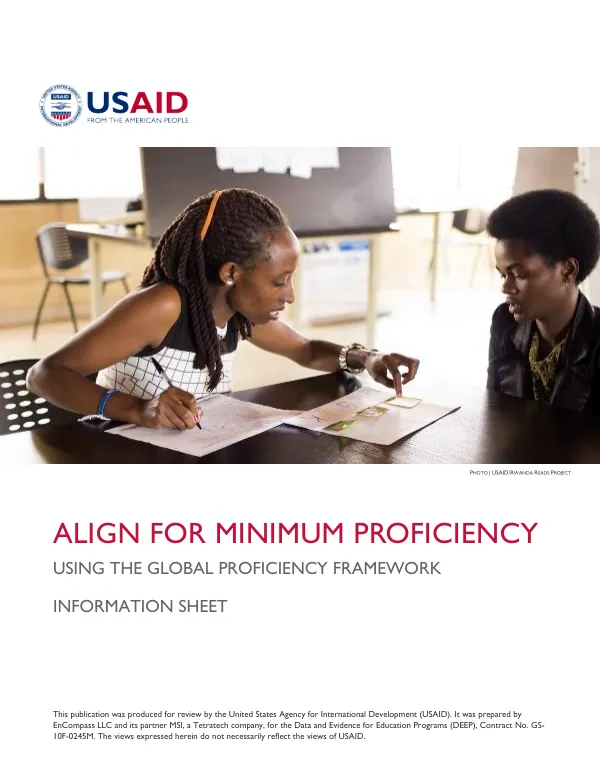
The ALIGN Kit: Resources for Developing Strategies to Improve Learner Performance in Reading and Math
Sign inUSAID
The ALIGN Kit: Resources for Developing Strategies to Improve Learner Performance in Reading and Math
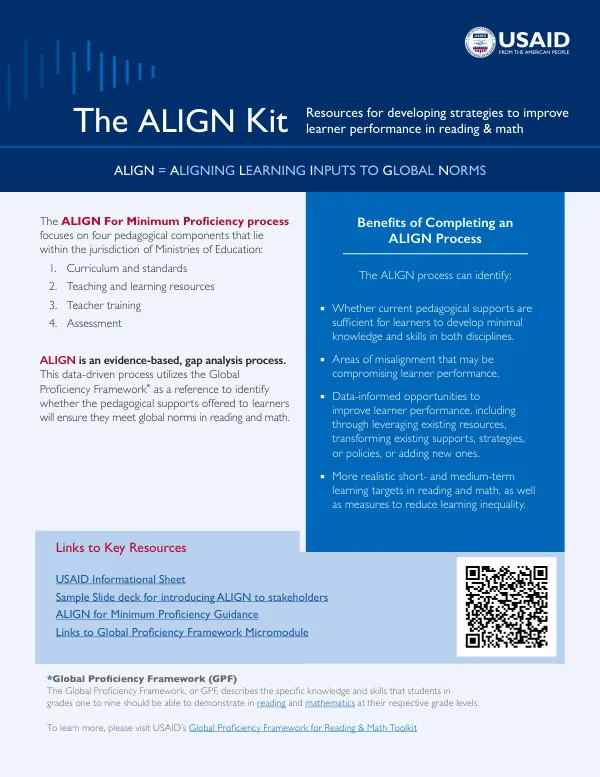
The ALIGN process is an evidence-based, gap analysis process designed to identify areas of misalignment in pedagogical supports that may be compromising learner performance in reading and math.
2 pages
Sign in to readA free account is required to download.
Abstract
This process utilizes the Global Proficiency Framework as a reference to determine whether the pedagogical supports offered to learners will ensure they meet global norms in reading and math. The ALIGN process focuses on four pedagogical components: curriculum and standards, teaching and learning resources, teacher training, and assessment. The Global Proficiency Framework describes the specific knowledge and skills that students in grades one to nine should be able to demonstrate in reading and mathematics at their respective grade levels. This framework serves as a reference for the ALIGN process, which aims to identify whether the pedagogical supports offered to learners will ensure they meet these global norms. The ALIGN process is designed to be adaptable to complex country contexts, including formal and non-formal education systems, as well as stable or crisis-affected contexts. The ALIGN process involves a gap analysis of the four pedagogical components, including curriculum and standards, teaching and learning resources, teacher training, and assessment. This analysis is guided by key questions and potential actions, which are designed to identify areas of misalignment and provide advice on preparing for and leading inquiry. The process is data-driven and utilizes the Global Proficiency Framework as a reference to identify opportunities to improve learner performance. The ALIGN process has several benefits, including the identification of areas of misalignment that may be compromising learner performance, the development of more realistic short- and medium-term learning targets, and the reduction of learning inequality. The process also provides advice on preparing for and leading inquiry across the four pedagogical components, including curriculum and standards, teaching and learning resources, teacher training, and assessment. The ALIGN process is supported by a range of resources, including the ALIGN Kit, which provides guidance on preparing for and leading inquiry across the four pedagogical components. This kit includes key questions and potential actions, as well as advice on data collection activities. Additionally, the process is supported by the Global Proficiency Framework, which provides a reference for the ALIGN process and describes the specific knowledge and skills that students in grades one to nine should be able to demonstrate in reading and mathematics at their respective grade levels.
Related documents