INTERNATIONAL LABOR ORGANIZATION
The Child Labor Initiative of USAID/Philippines
The Child Labor Initiative of USAID/Philippines aims to address the issue of child labor in the country.
2016 · 9 pages
Sign in to readA free account is required to download.
Abstract
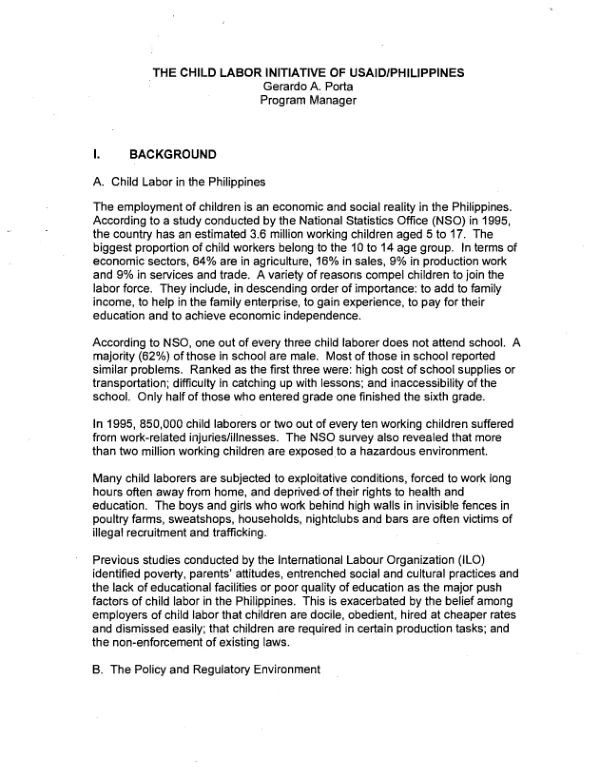
According to a study conducted by the National Statistics Office (NSO) in 1995, the Philippines has an estimated 3.6 million working children aged 5 to 17. The biggest proportion of child workers belong to the 10 to 14 age group, with 64% engaged in agriculture, 16% in sales, 9% in production work, and 9% in services and trade. Child laborers are often subjected to exploitative conditions, forced to work long hours away from home, and deprived of their rights to health and education. Poverty, parents' attitudes, entrenched social and cultural practices, and the lack of educational facilities or poor quality of education are identified as major push factors of child labor in the Philippines. The government has ratified several international conventions and laws related to child labor, including the United Nations Convention on the Rights of the Child and the International Convention on Economic, Social and Cultural Rights. However, the implementation of these laws and policies remains a challenge. The IPEC report highlights the need for improved enforcement of child labor laws, clarification of procedures and roles of partner agencies, and the reinstatement of a specialized court to hear child labor cases. Additionally, there is a need for stronger coordinating mechanisms between government agencies and monitoring and evaluation capabilities of implementors. The USAID child labor initiative will address these challenges by focusing on four key areas: poor enforcement of laws, weak coordinating mechanisms, shortage of services for child workers, and absence of implementing mechanisms for the code of conduct. The initiative will work with existing programs, including the Empowering Women and Children in the Informal Sector (ISP) and the Solidarity for Justice Project (SJP), to produce a more focused and collaborative response to the child labor issue. The ISP program, implemented by the American Center for International Labor Solidarity (ACILS) in partnership with the Trade Union Congress of the Philippines (TUCP), seeks to influence policy and regulatory reforms and improve the quality of life and employment of home-based women and child workers. The program has been successful in organizing local councils for the protection of children and has access to home-based industries where a large percentage of subcontracting work occurs. The Solidarity for Justice Project (SJP) also implemented by ACILS, TUCP, and other prominent partner organizations, supports the workers' struggle to claim and enforce their rights or seek redress when those rights are violated. The project has identified serious impediments and bottlenecks in the implementation of child labor laws and policies. The USAID child labor initiative aims to address these challenges and improve the lives of child workers in the Philippines. By working with existing programs and focusing on key areas, the initiative hopes to make a significant impact in reducing child labor and promoting the rights and well-being of child workers.
Related documents