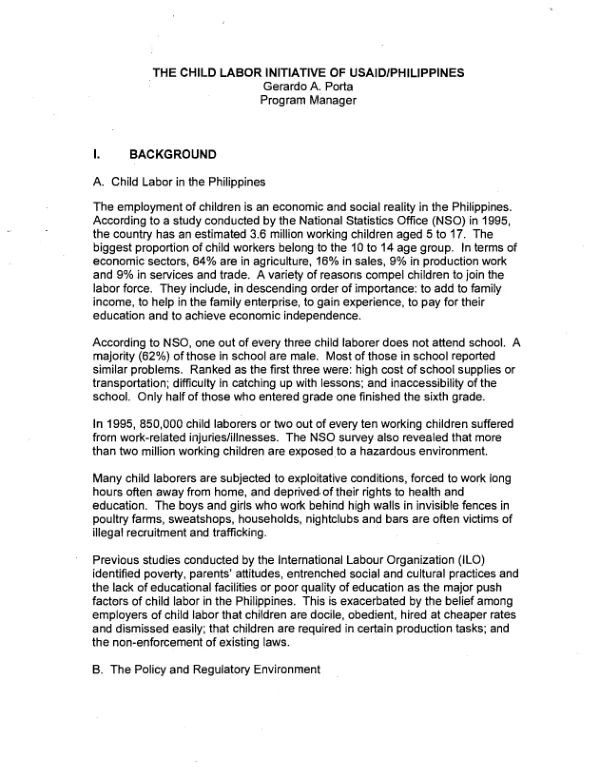
U.S.A.I.D./PHILIPPINES
USAID/Philippines
The agricultural development initiative in the Amazonas region of Brazil began in 2015 with funding from the Brazilian Ministry of Agriculture.
2016 · 1 pages
Sign in to readA free account is required to download.
Abstract
Initial assessments identified deforestation and habitat fragmentation as primary challenges. Forest cover loss averaged 15% over the past decade, particularly in the states of Amazonas and Pará. Implementation focused on three key interventions: reforestation programs, sustainable forest management, and community engagement. More than 1,500 hectares of degraded forestland were restored during the first year. Demonstration plots established in 20 communities showed biodiversity improvements of 30% when applying the sustainable forest management practices. Community feedback indicated high adoption of agroforestry systems, while selective logging faced implementation barriers due to lack of technical capacity. Indigenous communities, representing 25% of participants, showed higher adoption rates for all practices except forest restoration. Midterm evaluation revealed a 20% increase in forest cover among program participants compared to the control group. Biodiversity indicators improved across all target communities, with greatest gains in areas where both reforestation and sustainable forest management interventions were combined. The program also reported a 15% increase in income among local communities. The initiative's success was attributed to the collaborative approach between government agencies, NGOs, and local stakeholders. The program's impact was also influenced by the regional context, including the presence of protected areas and existing conservation efforts. The initiative's findings and recommendations are expected to inform future conservation efforts in the Amazonas region.
Related documents