USAID DEC
The complex relationship between human immunodeficiency virus infection and death in adults being treated for tuberculosis in Cape Town, South Africa
Sign inIMPERIAL COLLEGE LONDON
The complex relationship between human immunodeficiency virus infection and death in adults being treated for tuberculosis in Cape Town, South Africa
The complex relationship between human immunodeficiency virus (HIV) infection and death in adults being treated for tuberculosis (TB) in Cape Town, South Africa, is a significant public health concern.
2015 · 8 pages
Sign in to readA free account is required to download.
Abstract
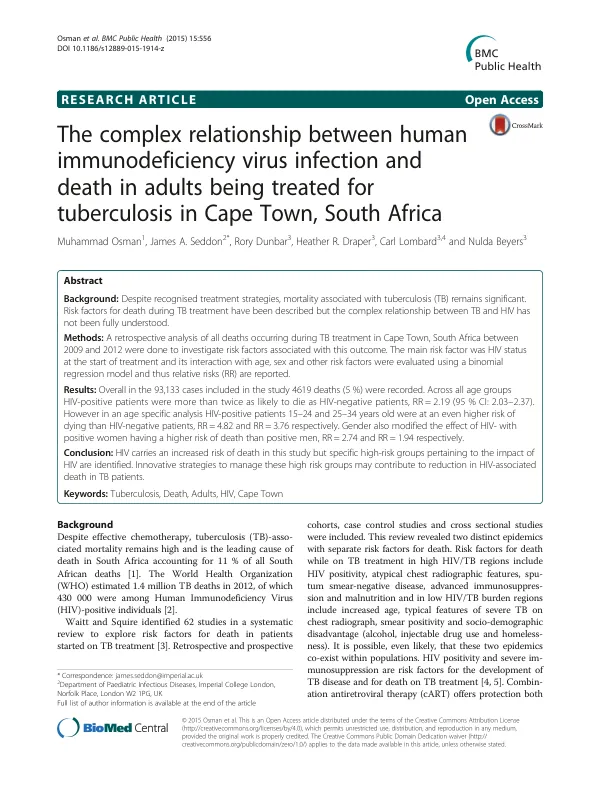
Despite effective chemotherapy, TB-associated mortality remains high and is the leading cause of death in South Africa, accounting for 11% of all South African deaths. The World Health Organization (WHO) estimated 1.4 million TB deaths in 2012, of which 430,000 were among HIV-positive individuals. Risk factors for death while on TB treatment have been described, but the complex relationship between TB and HIV has not been fully understood. A retrospective analysis of all deaths occurring during TB treatment in Cape Town, South Africa, between 2009 and 2012, was conducted to investigate risk factors associated with this outcome. The study included 93,133 cases, with 4,619 deaths (5%) recorded. HIV-positive patients were more than twice as likely to die as HIV-negative patients, with a relative risk (RR) of 2.19 (95% confidence interval: 2.03-2.37). However, in an age-specific analysis, HIV-positive patients 15-24 and 25-34 years old were at an even higher risk of dying than HIV-negative patients, with RR of 4.82 and 3.76, respectively. Gender also modified the effect of HIV, with positive women having a higher risk of death than positive men, with RR of 2.74 and 1.94, respectively. The study highlights the need for innovative strategies to manage high-risk groups, particularly young HIV-positive individuals and women. The study was conducted in the City of Cape Town district, which reported a decrease in reported TB cases per population from 877/100,000 in 2009 to 663/100,000 in 2013, with a cure rate of 83% among all patients who started TB treatment in 2013. Laboratory diagnosis of TB in Cape Town utilized smear microscopy, culture, and line probe assay until August 2011, after which the GeneXpert MTB/RIF assay (Xpert) was progressively introduced for the testing of all patients with presumptive TB. TB treatment regimens were in accordance with international standards, and HIV testing was performed using rapid testing according to National guidelines. The study population included all TB patients treated for drug-susceptible TB in the City of Cape Town district, recorded in the electronic database (ETR.net), which includes patient-specific details, disease-specific details, and TB outcome. The study used a binomial log-linear regression model to determine which demographic and clinical characteristics were associated with death, and relative risks (RRs) and 95% confidence intervals (CIs) were reported. The study highlights the importance of understanding factors associated with death while on TB treatment to develop strategies to strengthen the TB control programme.
Related documents