USAID DEC
Health system barriers to implementation of TB preventive strategies in South African primary care facilities
Sign inWITKOPPEN HEALTH AND WELFARE CENTRE
Health system barriers to implementation of TB preventive strategies in South African primary care facilities
The implementation of isoniazid preventive therapy (IPT) in South African primary care facilities is a critical component of TB/HIV control.
2019 · 12 pages
Sign in to readA free account is required to download.
Abstract
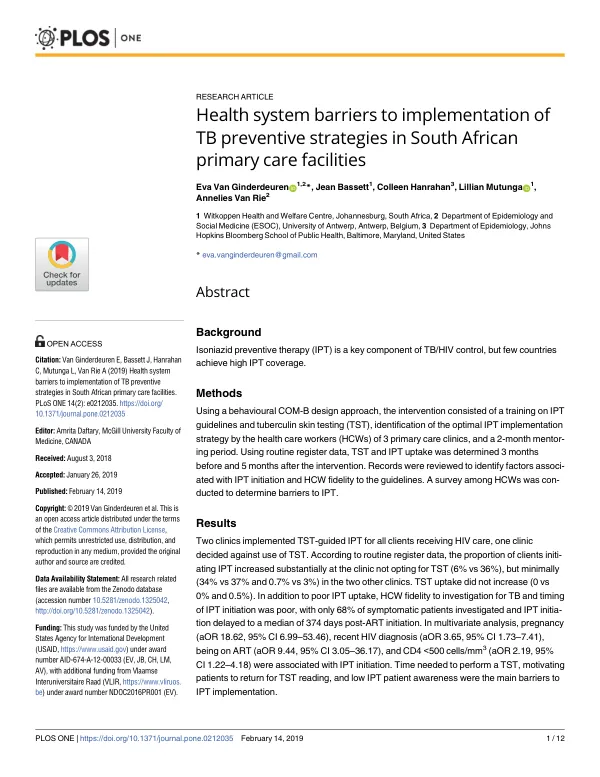
IPT reduces the progression of latent Mycobacterium tuberculosis infection to TB disease in those at high risk. The Global Plan to STOP TB aims to initiate IPT in 90% of all people living with HIV and 90% of all children in contact with TB by 2025. South Africa carries one of the world's highest TB/HIV burdens, with close to one in every 100 South Africans developing active TB disease each year. Despite the importance of IPT, few countries achieve high IPT coverage. In South Africa, while 56% of people living with HIV are initiated on antiretroviral treatment (ART), less than 10% start IPT. Recent qualitative work assessing barriers to IPT implementation from the point of view of South African HIV care providers has suggested that the primary barrier to IPT use was lack of knowledge and experience. Other barriers reported in the literature were inaccuracy of TB screening tools to exclude active TB, fear of isoniazid resistance, isoniazid and tuberculin shortage, and lack of clear guidance. A study conducted in three primary care health facilities serving the Diepsloot community in Northern Johannesburg used a behavioural COM-B design approach to identify barriers to IPT implementation and design an intervention to improve IPT uptake. The intervention included training to enhance capability, a participatory design to create opportunities for IPT initiation, and mentored implementation and feedback to increase motivation. Following implementation, the study evaluated IPT and TST uptake, determined health care worker (HCW) fidelity to the 2014 South African IPT guidelines, and identified remaining barriers for IPT and TST implementation as perceived by HCWs. The study found that despite using a behavioural intervention framework, HCW fidelity to the guidelines was poor, resulting in low TST coverage and low IPT uptake under primary care conditions. The proportion of clients initiating IPT increased substantially at one clinic, but minimally in the two other clinics. TST uptake did not increase in any of the clinics. In addition to poor IPT uptake, HCW fidelity to investigation for TB and timing of IPT initiation was poor, with only 68% of symptomatic patients investigated and IPT initiation delayed to a median of 374 days post-ART initiation. Multivariate analysis revealed that pregnancy, recent HIV diagnosis, being on ART, and CD4 <500 cells/mm3 were associated with IPT initiation. Time needed to perform a TST, motivating patients to return for TST reading, and low IPT patient awareness were the main barriers to IPT implementation. The study concluded that to achieve the benefits of IPT, health system level approaches including TST-free guidelines and sensitization are needed.
Related documents