USAID DEC
The development potential of new lands settlement in the tropics and subtropics : a global state of the art evaluation with specific emphasis on policy implications
Sign inUSAID. BUR. FOR DEVELOPMENT SUPPORT. OFC. OF RURAL DEVELOPMENT AND DEVELOPMENT ADMINISTRATION
The development potential of new lands settlement in the tropics and subtropics : a global state of the art evaluation with specific emphasis on policy implications
The spontaneous or sponsored settlement of largely uncultivated areas has markedly increased since World War II due to population growth, large-scale disease control, and national development planning.
Scudder, Thayer · 1981
Sign in to readA free account is required to download.
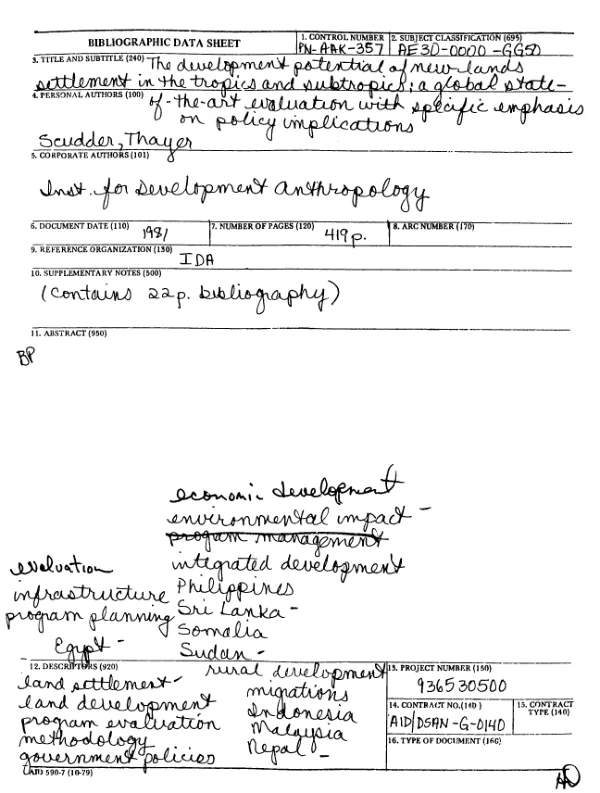
Abstract
This state-of-the-art analysis is designed to improve the design, implementation, management, and evaluation of future new lands settlement. Against background descriptions of types of settlers and settlements and definitions of settlement success, the author presents the method by which he prepared his study - a review of the literature and field visits to Indonesia, Malaysia, Nepal, the Philippines, Somalia, Sri Lanka, and Sudan. The dynamics of and the issues to be addressed during the four stages of new lands settlement are detailed. The first stage entails planning, initial infrastructure development, and settler recruitment. Next occurs a period of transition for both the migrant families and the settlement itself. In the third stage, the settlement witnesses socioeconomic development as the previously risk-averse settlers become risk-takers. Finally, administration of the settlement is transferred to the settlers themselves, a step critical to success. Concluding that government-sponsored settlements" full potential as catalysts to area development has yet to be realized, the author describes an ideal settlement process characterized by: (1) several thousand settler families; (2) use of appropriate and diversified farming systems, emphasizing crop and livestock production rather than off-farm activities; (3) significant yet decentralized host government involvement from the outset; (4) detailed pre-settlement planning; (5) a hierarchically organized system of nucleated communities; (6) the phased provision of infrastructure; (7) emphasis on economic assistance rather than social infrastructure and housing; (8) participation of local beneficiaries; (9) adequate marketing facilities; and (10) ongoing monitoring and evaluation of progress. Appended are a descriptive list of the settlements studied; a questionnaire for first generation settlers; and a 133-item bibliography (1954-81).
Related documents