USAID DEC
The Effect of Fertility Behavior on Child Survival: Evidence from the Demographic and Health Surveys (AS88) - Analysis Brief
Sign inICF
The Effect of Fertility Behavior on Child Survival: Evidence from the Demographic and Health Surveys (AS88) - Analysis Brief
The global decline in childhood mortality rates over the past three decades has been a significant public health achievement.
3 pages
Sign in to readA free account is required to download.
Abstract
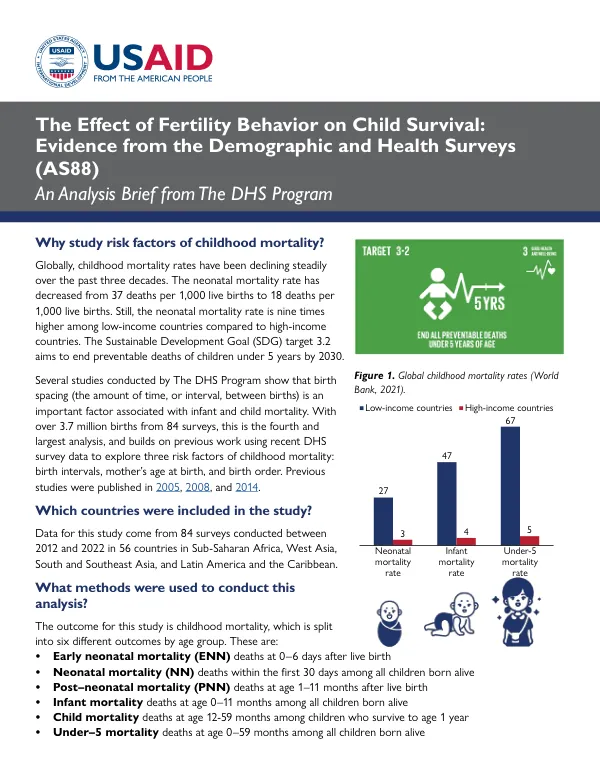
However, the neonatal mortality rate remains nine times higher in low-income countries compared to high-income countries. The Sustainable Development Goal (SDG) target 3.2 aims to end preventable deaths of children under 5 years by 2030. Research conducted by The DHS Program has consistently shown that birth spacing is an important factor associated with infant and child mortality. Data from 84 surveys conducted between 2012 and 2022 in 56 countries across Sub-Saharan Africa, West Asia, South and Southeast Asia, and Latin America and the Caribbean were pooled into one dataset to allow for better estimation of mortality risks. The study examined the relationship between childhood mortality and three key risk factors: birth interval, mother's age at birth, and birth order. Each variable has high-risk categories for types of births known to be associated with higher rates of childhood mortality. The study found that short birth intervals are associated with increased risk of mortality for all age groups. Children conceived within 6 months of the birth of their next oldest sibling are 2.5 times more likely to die in the first week of life (early neonatal mortality) and 3.6 times more likely to die before their fifth birthday (under-5 mortality). First-born children have a higher risk of all measures of childhood mortality except child mortality (deaths between ages 1 and 5) than children who were conceived three to four years after their next oldest sibling. Children born to mothers under age 18 and over age 40 have an increased risk of all measures of childhood mortality, compared to children born to mothers age 18 to 24. The frequency of short birth intervals and births to women under age 18 has declined since the previous study, which may have contributed to observed declines in infant mortality in recent years. The findings of this study reinforce those of previous studies in this series, highlighting the importance of addressing specific fertility risks to achieve SDG target 3.2. Policies and programs should be developed to address these risks, including short birth intervals, first births, higher order births, and births to younger and older women.