USAID DEC
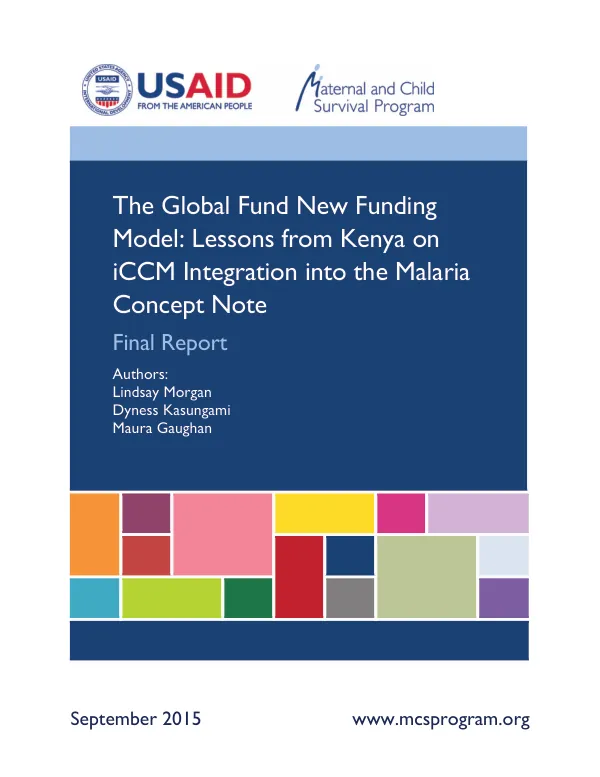
The Global Fund New Funding Model: Lessons from Kenya on iCCM Integration into the Malaria Concept Note
Sign inBROAD BRANCH ASSOCIATES
The Global Fund New Funding Model: Lessons from Kenya on iCCM Integration into the Malaria Concept Note
Kenya has made significant progress in reducing childhood mortality and morbidity over the last decade.
2015 · 24 pages
Sign in to readA free account is required to download.
Abstract
The under-five mortality rate decreased by 36 percent between 2003 and 2009, from 115/1,000 live births to 74/1,000, respectively. The infant mortality rate also decreased by 32 percent, from 77/1,000 in 2003 to 52/1,000 in 2009. Neonatal mortality is 31 deaths per 1,000 live births, while post-neonatal mortality is 21 per 1,000 live births. Despite these gains, much remains to be done. One in every 19 children born in Kenya dies before their first birthday, and one in every 14 does not survive to age five. In 2011, the World Health Organization estimated that a total of 188,928 children under-five died in Kenya, with 38,892 deaths caused by diarrhea, 20,666 by malaria, and 30,406 by pneumonia. The Kenyan health system is organized into various levels, including health facilities, community health services, and community health extension workers. The Ministry of Health is responsible for overseeing the health sector, while international donors, government, and health system policymakers, program managers, and healthcare providers work together to implement health programs. Integrated Community Case Management (iCCM) is a strategy that extends case management of childhood illness to populations underserved by health facilities. This approach aims to provide lifesaving treatments for the most common causes of mortality and morbidity among children. iCCM has gained recognition as an important strategy to complement investments at the facility and other levels. The Global Fund New Funding Model (NFM) is a mechanism that can support the platform costs of case management for child illness beyond malaria. The NFM can be used to integrate other interventions into the iCCM strategy and community platform. In Kenya, the experience with the NFM was explored in the context of integrating iCCM into a malaria concept note. The report reviews the challenges experienced during the discussions between malaria and child health stakeholders in Kenya. It also explores the reasons why financial and programmatic integration of iCCM and malaria through the NFM proved untenable in Kenya's case. The report is part of a series exploring iCCM integration in five countries, including Ghana, Nigeria, Uganda, and Zambia. The Demographic and Health Survey (DHS) 2008-2009 shows that only 50 percent of children in malaria-endemic areas of Kenya have access to lifesaving treatments for malaria. This highlights the need for improved access to treatments for preventable and treatable illnesses among children in Kenya. The World Health Organization estimates that a total of 188,928 children under-five died in Kenya in 2011, with a significant proportion of these deaths caused by malaria, diarrhea, and pneumonia. The Kenyan government and international donors are working together to implement health programs that aim to reduce child mortality and morbidity. The Ministry of Health is responsible for overseeing the health sector, while community health extension workers and community health services play a crucial role in providing healthcare to underserved populations. The Global Fund New Funding Model is being explored as a mechanism to support the integration of iCCM and other interventions into the health system in Kenya.