USAID DEC
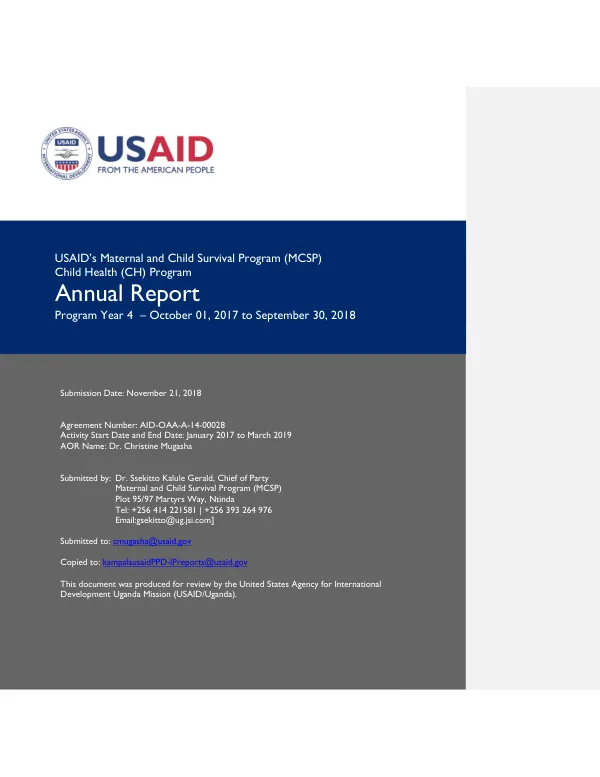
Annual Report: Maternal and Child Survival Program (MCSP) Child Health (CH) Program Year 4
Sign inCLINTON HEALTHCARE ACCESS INITIATIVE
Annual Report: Maternal and Child Survival Program (MCSP) Child Health (CH) Program Year 4
The Maternal and Child Survival Program (MCSP) Child Health (CH) Program is a global initiative of the United States Agency for International Development (USAID) aimed at preventing child and maternal deaths in 27 priority countries.
2018 · 41 pages
Sign in to readA free account is required to download.
Abstract
In Uganda, MCSP is implementing two programs: the Routine Immunization program (MCSP RI) and the Child Health program (MCSP CH). The MCSP CH program is a 24-month technical assistance (TA) program that provides tailored support to the Regional Health Integration to Enhance Services (RHITES) projects in the South West (SW) and East Central (EC) regions. The program's strategic objective is to provide above-site technical assistance to the RHITES projects in the SW and EC regions. The program's intermediate results include enhancing national guidelines and frameworks for the implementation of the essential child health package, and strengthening the competencies and practices of RHITES partners and MCSP demonstration districts to implement the essential child health package. The program's sub-intermediate results include increasing the proportion of cases of children under 5 years of age diagnosed with malaria through RDT and/or microscopy testing who received ACT treatment during the last quarter, and increasing the proportion of cases of children under 5 years of age with fever seeking care at health facilities who received RDT and/or microscopy testing for malaria during the last quarter. The program's performance analysis to date shows that the proportion of cases of children under 5 years of age diagnosed with malaria through RDT and/or microscopy testing who received ACT treatment during the last quarter has increased in all demonstration districts. In Luuka, the proportion increased from 85% in Q1 to 98.3% in Q4. In Kaliro, the proportion increased from 85% in Q1 to 100.4% in Q2. In Ntungamo, the proportion increased from 83.3% in Q1 to 98.4% in Q3. In Sheema, the proportion increased from 84.2% in Q1 to 100% in Q4. The program's performance analysis also shows that the proportion of cases of children under 5 years of age with fever seeking care at health facilities who received RDT and/or microscopy testing for malaria during the last quarter has increased in all demonstration districts. In Luuka, the proportion increased from 84.4% in Q1 to 98.1% in Q4. In Kaliro, the proportion increased from 87.4% in Q1 to 95.9% in Q3. In Ntungamo, the proportion increased from 99.5% in Q1 to 98.5% in Q4. In Sheema, the proportion increased from 4.3% in Q1 to 93.8% in Q3. The program's implementation update for Program Year 4 (PY4) covers the period from October 2017 to September 2018. The program's activities during this period included providing technical assistance to the RHITES projects in the SW and EC regions, and supporting the implementation of the essential child health package in the demonstration districts. The program's achievements during this period include the development of national guidelines for catchment area planning and mapping for action, and the strengthening of the competencies and practices of RHITES partners and MCSP demonstration districts to implement the essential child health package. The program's geographic coverage includes the national level (Kampala) and four demonstration districts of Luuka, Kaliro, Ntungamo, and Sheema. The program's reporting period is from October 01, 2017 to September 30, 2018. The program's agreement number is AID-OAA-A-14-00028, and the program's activity start date and end date are January 2017 to March 2019. The program's prime implementing partner is Jhpiego, and the program's subcontractors/sub-awardees include John Snow, Inc (JSI). The program's major counterpart organizations include Regional Health Integration to Enhance Services (RHITES) East Central and RHITES South Western.