USAID DEC
The global spectrum of plant form and function: enhanced species-level trait dataset
Sign inUSAID DEC
The global spectrum of plant form and function: enhanced species-level trait dataset
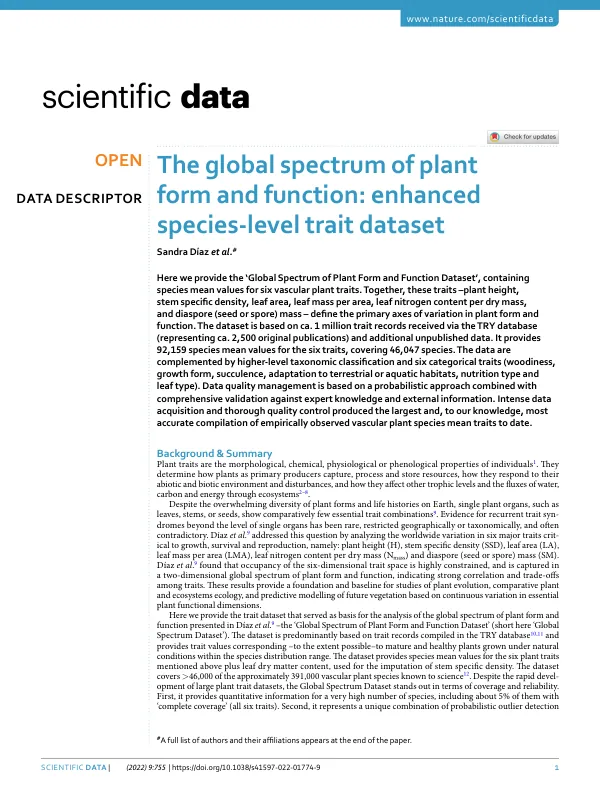
The Global Spectrum of Plant Form and Function Dataset contains species mean values for six vascular plant traits.
2022 · 18 pages
Sign in to readA free account is required to download.
Abstract
These traits - plant height, stem specific density, leaf area, leaf mass per area, leaf nitrogen content per dry mass, and diaspore mass - define the primary axes of variation in plant form and function. The dataset is based on approximately 1 million trait records received via the TRY database, representing around 2,500 original publications, and additional unpublished data. It provides 92,159 species mean values for the six traits, covering 46,047 species. The dataset is complemented by higher-level taxonomic classification and six categorical traits, including woodiness, growth form, succulence, adaptation to terrestrial or aquatic habitats, nutrition type, and leaf type. Data quality management is based on a probabilistic approach combined with comprehensive validation against expert knowledge and external information. This approach ensures that the dataset is accurate and reliable, with intense data acquisition and thorough quality control producing the largest and most accurate compilation of empirically observed vascular plant species mean traits to date. The dataset was developed over a period of six years, from 2009 to 2015, with continuous addition of new trait records as data became available. The final dataset is based on almost 1 million trait records, which can be traced back to around 2,500 references. The dataset was developed to capture the essence of plant form and function at the broad scale, with the six core traits chosen - plant height, stem specific density, leaf area, leaf mass per area, leaf nitrogen content per dry mass, and diaspore mass - capturing roughly three-quarters of total trait variation. The dataset includes the names and definitions used for the continuous traits, as well as the names and definitions used in the Thesaurus Of Plant Characteristics (TOP). The categorical traits are also included, with names, definitions, and categories used in the database. The dataset was developed following the protocols and definitions specified in the 'New Handbook for Standardised Measurement of Plant Functional Traits Worldwide' and the LEDA project. The dataset provides a foundation and baseline for studies of plant evolution, comparative plant and ecosystems ecology, and predictive modeling of future vegetation based on continuous variation in essential plant functional dimensions. It is a unique combination of probabilistic outlier detection and comprehensive validation of trait values against expert knowledge and external information, making it the most comprehensive and probably most accurate dataset for species mean traits of vascular plants published so far. The dataset covers a wide range of vascular plant species, including around 5% of them with 'complete coverage' (all six traits). It represents a unique combination of probabilistic outlier detection and comprehensive validation of trait values against expert knowledge and external information, making it the most comprehensive and probably most accurate dataset for species mean traits of vascular plants published so far. The dataset is available for download and can be used for a variety of research purposes, including studies of plant evolution, comparative plant and ecosystems ecology, and predictive modeling of future vegetation.