USAID. MISSION TO BOLIVIA
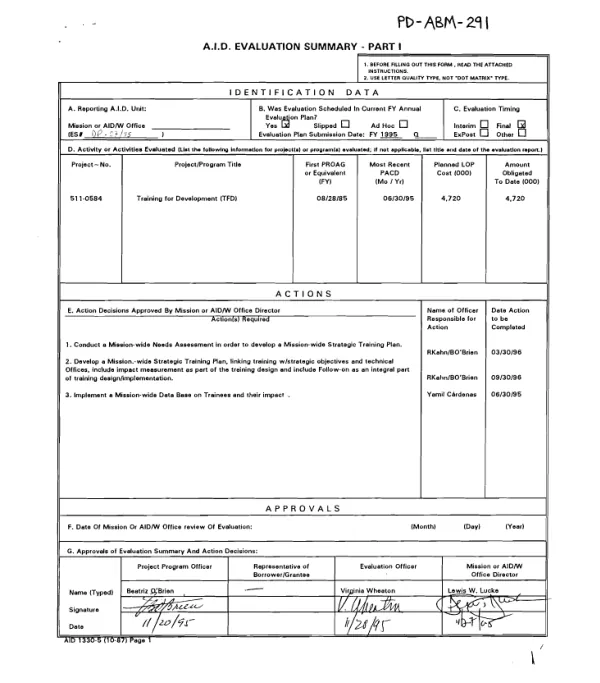
Project assistance completion report : training for development (511-0584)
PACR of a project (8/85-6/95) to increase the supply of U.S.-trained leaders and policy makers in Bolivia.
1995
Sign in to readA free account is required to download.
Abstract
This was a successful project, which reached leaders and potential leaders, trained a significant number of women, and satisfied a felt need for qualified professionals in the private and public sectors. The three components (long-, short-term, and in-country training) had tremendous success and reached populations from throughout Bolivia, although the majority of participants were from the larger departments. Quantitative targets were exceeded. A total of 63 long-term participants, including 15 women, were trained. Short-term participants totaled 172, including 50 women. The project"s Democracy Awareness component, terminated after only 2 years due to the start-up of the Andean Peace Scholarship Program, provided short-term U.S. training to 60 socioeconomically disadvantaged individuals. The in-country component, funded with local currency, was implemented via an agreement with IDEA, a local institution with programs geared to management training; 338 participants were trained, including 104 women, Fields in which participants were trained included business, economics, finance, agribusiness, banking, women in development and leadership, public administration, the environment, health, demography, and project design and evaluation. Training resulted in qualitative achievements. Most, if not all, Master"s participants have worked themselves into decision-making positions in the public and private sectors. Positions held include President of the Central Bank, Secretary of Finance, Director General Accounting Office, Director National Institute for Statistics, Minister of Finance. In addition, participants are serving as bank executives, government advisors, CEOs, directors of important projects in the public sector, and consultants to international organizations. The following lessons were learned. (1) The project did not set any limitations as to the income and social status of applicants, but sought individuals with potential. Many who applied for scholarships were required to make a partial financial contribution, but the majority were not so required. With few exceptions, future programs should seek participant contribution towards the cost of training. (2) Targets to train women should be determined based on real populations of women. (3) Outputs and impact expected must be clearly stated. Persons trained is not an adequate impact indicator. (4) Agreements among employers, trainees, and funders prior to training must be realistic, enforceable, and must promote productive utilization of the skills acquired by the trainee. Agreements should not be used merely as legalistic instruments.
Related documents