USAID DEC
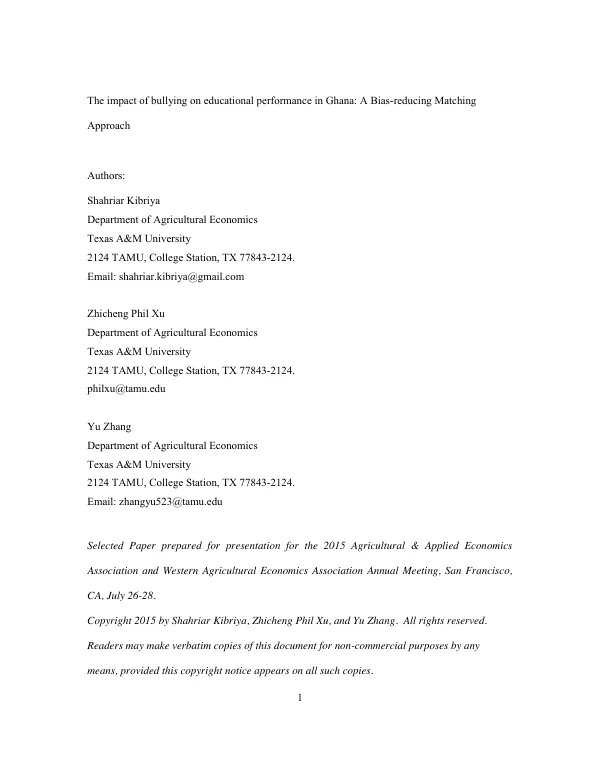
The impact of bullying on educational performance in Ghana: A Bias-reducing Matching Approach
Sign inTEXAS A&M INTERNATIONAL UNIVERSITY
The impact of bullying on educational performance in Ghana: A Bias-reducing Matching Approach
The impact of bullying on educational performance in Ghana is a significant concern, with evidence suggesting that bullying has a negative effect on academic performance.
2015 · 30 pages
Sign in to readA free account is required to download.
Abstract
Using data from the Trends in International Mathematics and Science Study, researchers found that bullying has a detrimental impact on students' academic achievement. The study also revealed that female students are more affected by bullying, but the presence of a female teacher in the classroom can mitigate this negative effect. The researchers employed a quasi-experimental propensity score matching and OLS methods to analyze the data, followed by a series of robustness tests to validate the unconfoundedness and overlapping assumptions. The results of the study suggest that bullying can have a significant impact on students' academic performance, and that female students are disproportionately affected. The study's findings have important implications for policymakers, who are encouraged to introduce gender-sensitive anti-bullying programs in academic settings. The researchers also highlight the need for further studies to explore the causal link between bullying and academic performance, particularly in developing countries. Bullying can impact academic performance in various ways, including by affecting students' mental health, social relationships, and academic engagement. Victims of bullying are more likely to report feeling unhappy and lonely at school, and having fewer good friends. They are also more likely to develop new psychosomatic and psychosocial problems, which can have a negative impact on their academic performance. The relationship between bullying and academic performance has been explored in various studies, with most research finding a direct association between bullying and poor academic performance. However, the causal direction of this relationship remains unclear, and it is possible that a student's lower academic performance may be a result of being bullied, rather than the other way around. To address the challenges of drawing causal inferences about the relationship between bullying and academic performance, the researchers employed a non-parametric method (propensity score matching) to control for potential confounding variables. This approach allowed them to isolate the effect of bullying on academic performance, while also accounting for the potential endogeneity bias and over-selection concerns. The study's findings have important implications for policymakers and educators, who can use this research to inform the development of anti-bullying programs and policies that address the specific needs of female students in Ghana. By understanding the impact of bullying on academic performance, policymakers can take steps to create a safer and more supportive learning environment for all students.
Related documents
Documents in this collection
 2016
2016USAID DEC
Leveraging open-source technology and adapting open eLearning content to improve the knowledge and motivation of Ghana’s rural nurses
Open record 2019
2019USAID DEC