WINROCK INTERNATIONAL FOUNDATION
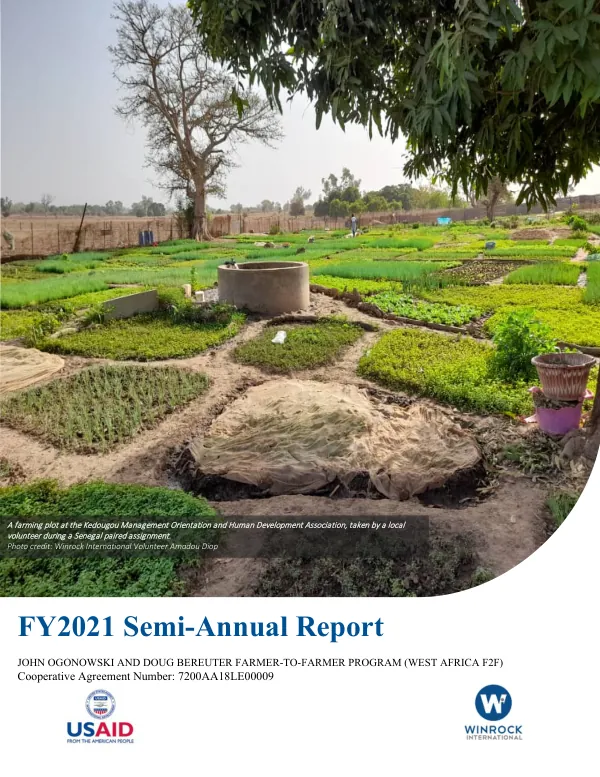
FY2021 Annual Report: West Africa Farmer-to Farmer Program
The West Africa Farmer-to-Farmer Program is a five-year USAID-funded initiative implemented by Winrock International in cooperation with subawardees Browse and Grass Growers Cooperative (BGGC) and National Peace Corps Association (NPCA).
2021 · 28 pages
Sign in to readA free account is required to download.
Abstract
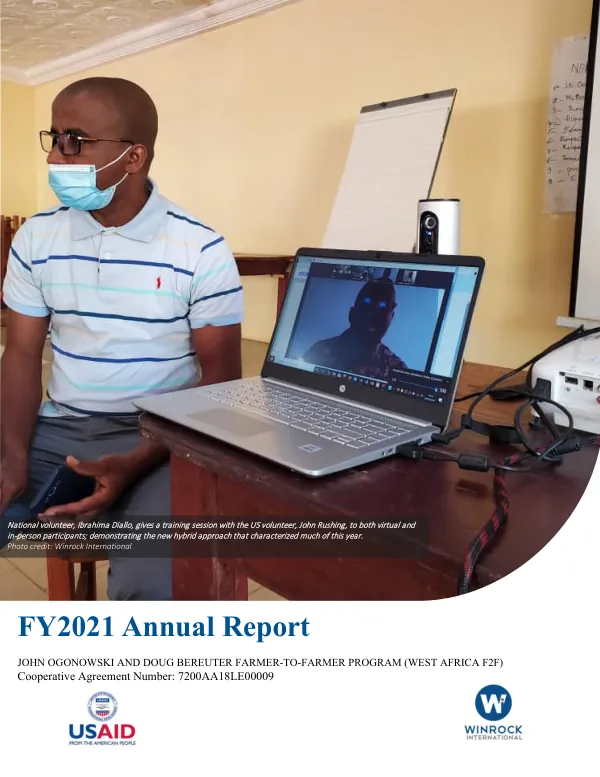
The program operates in Ghana, Guinea, Mali, Nigeria, and Senegal, with the goal of improving agricultural productivity and rural livelihoods. In the third year of the project, from October 1, 2020 to September 30, 2021, West Africa F2F completed 48 volunteer trips, directly training 1,119 participants (47% female) and supported 41 host organizations in the five core countries. During this time period, West Africa F2F also completed an additional 48 fully remote assignments, supporting an additional 24 hosts. The program ramped up paired assignment implementation, where remote US volunteers were paired with host country national volunteers to jointly conduct trainings for host organizations in all five core countries. This approach allowed host organizations to receive more hands-on trainings through virtual connections with the US volunteers and the national volunteers incorporating new and improved practices and/or curriculum directly with beneficiaries. In Ghana, F2F volunteers completed 10 fully remote assignments and 10 paired assignments, supporting 19 hosts. Paired assignments were especially important for postharvest quality topics that require more hands-on training. F2F volunteers provided hands-on training on topics including postharvest handling of organic fruits and vegetables, agrochemical application compliance, and value-added processing of organic fruits and vegetables. This training provided critical capacity building for hosts seeking to produce higher quality fruits and vegetables that meet export requirements. In addition to postharvest quality, F2F volunteers also provided trainings in business plan development, financial record keeping, business management, proposal development, and marketing strategies – as foundational topics that help small postharvest businesses to become more stable and sustainable. Highlights of the program's work in Ghana include a US remote volunteer paired with a national volunteer to train 26 members of the Participatory Guarantee System Ghana in value-added processing for organic fruits and vegetables. The volunteers worked together to create a training manual on procedures, materials, analytical methods, and calculations to process organic fruits and vegetables. The program also completed an additional 48 fully remote assignments, supporting an additional 24 hosts. Fully remote assignments were especially beneficial for Agriculture Education and Training (AET) assignments, where webinars focused on curriculum development or pedagogy were able to reach larger audiences of educators via virtual platforms. As part of the program's midterm analysis, West Africa F2F staff completed 51 host impact surveys. Volunteer Emily Fendley worked with F2F staff to analyze midterm progress, impacts, and lessons learned, which are detailed in the Highlights of Major Impacts or Accomplishments and Lessons Learned section of this report. The program also began work to launch a F2F Diversity Initiative pilot, through a buy-in received during the second half of FY21. This initiative aims to increase diversity and inclusion in the program's volunteer pool and host organizations. The program's work in Ghana, Guinea, Mali, Nigeria, and Senegal has made significant progress in improving agricultural productivity and rural livelihoods, and the program continues to adapt and evolve to meet the changing needs of its host countries.
Related documents